Showing posts with label Movies. Show all posts

Wednesday, September 26, 2007

An action masterpiece is Bourne


On the whole, Bourne Ultimatum can be slightly disappointing precisely because it’s not gratifying like action movies usually are. Not much is blown up on screen and as you leave the hall you can’t help but ask yourself, “What kinda action movie was that?”

Ultimatum, the third in the Bourne series, is also paced the fastest and the most political of the three movies, based loosely on Robert Ludlum’s novels of the same name.

During the movie's climax, an unarmed Bourne stands on the edge of a Manhattan rooftop close to the CIA’s anti-terrorism building in New York and asks the agent who has a gun cocked at him, “Do you even know why you're supposed to kill me? Look at us. Look at what they make you give.” This is as political as the monosyllabic assassin is ever going to get. That Bourne too has to get obvious and point fingers at the CIA and the government machinery is such a pity because this series, more than any other in recent times, has surprised audiences and redefined the action genre. Not once before in this series have proceedings gotten this literal.

Up until now, the psychological baggage that came with the movie was always underneath its boiling surface, like an ugly creature that can’t quite keep its head down. Except for the character Pamela Landy played with superb authority by Joan Allen and Nicky Parsons (Julia Stiles), most of the CIA is characterised as filled with officials who are too paranoid and kill in order not to be killed.

Matt Damon plays Bourne with sunken eyes that have deep, dark circles beneath them. Gone is the air of the successful action hero – just imagine the differences between the Arnold Schwarzenegger-starrer hit Commando and this film, and you will know what I mean.

After strangling to death an assassin in the loo of a building in Tangiers, Morocco, Damon for a minute looks as if he is crying. Clearly, murdering in cold blood is not easy for this assassin. What is even more surprising is the look of shock on face of Julia Stiles, a girlfriend Bourne doesn’t remember from the past. Later, we cut to Bourne’s crushed hands from the fistfight that precedes the murder. This is also a strange shot for an action movie because we never get to see an injury unless, like in Rambo, the hero is trying to get a bullet out of his shoulder or something. Clearly, Bourne is a vulnerable assassin, whose injures, both physical and mental, bother him tremendously. Perhaps, the mental ones, those that we never see, are harder to deal with. Damon always plays Bourne with his ghosts intact.

Ultimatum begins from where Supremacy left. After apologising to Neski’s daughter for killing her parents – whoever has apologised for killing in an action movie before – Bourne escapes from Moscow. (The Neskis are Bourne’s first targets. That tale is told in Supremacy.)

Though the globe trotting spy is common to both series, what differentiates Bourne from Bond is that Bourne is an assassin with a heart. In the next scene, you see Bourne meeting Marie’s brother (Marie is his girlfriend who is killed in Supremacy) and informing him about her death. Director Paul Greengrass lingers on the scene for a while longer that most directors would, impressing upon the audience the conflict Bourne faces all through the series.

Bourne wants revenge, and when he sees an article in the Guardian by its security correspondent, he arranges a meeting with him in London’s waterloo station. The CIA is already on the correspondent’s heels and the Waterloo sequence in an ideal example of the kind of tense sequences that the series has thrown our way. The sequence is shot in a jittery fashion that makes you teeth chatter. The editing may seem like the work of a director recklessly putting together shots in no logical sequence. But it isn’t. The effect caused by the editing that has marked the last two movies of the series is innovative and unsettling. I was amazed to see a number of top angle shots merged seamlessly with eye-level shots of Bourne on the move.

Later in the movie, in a sequence reminiscent of the one in Identity where he talks with the Frank Potente character, Bourne converses with Stiles in a café in Madrid. This time Bourne doesn’t talk much as he did then. Nicky talks a bit. She tells him how difficult it was for her to let him join the program. And pause. Greengrass cuts to Stiles to Damon to Stiles. He does this a couple of times. And then, Nicky asks, “You don’t remember anything, do you?” This is another sequence in which Greengrass excels himself; the issues troubling Bourne during the course of his peculiar life are never again as apparent.

Much of what bothers the amnesiac is from Ludlum’s best-selling series. In the novels, Bourne is sent undercover during the height of the Cold War to kill the Russian terrorist known as Carlos the Jackal. During an assignment, Bourne is shot and loses his memory. He can feel he is an assassin, but for whom? Are his murderous acts somehow vindicated? Ludlum doesn’t go to the extent of questioning the CIA’s assassination program simply because it isn’t there in his novels. That’s something that scriptwriter Tony Gilroy and others thought of as a post 9/11 addendum. Much of the plot that Ludlum expands upon in great detail is discarded. Instead, a more modern one that is meaningful to the current scenario is written in.

And 9/11 is something that has interested Greengrass. His last movie was United-93, the story of the one plane that never found its target during the 9/11 attacks.

I can straightaway name two aspects common to all three Bourne movies: The fistfight like the one in Tangiers in Ultimatum and the climatic car chase. The fistfight in a closed room with the cameraman prancing about like the fighters themselves is something pioneered by the Bourne series. And so is the no-holds barred, death-take-all car chase. Each time, Bourne’s car is wrecked. He wrecks two cars in Ultimatum, the first time after driving one off a roof and the second – an NYPD car – is crashed into a tunnel. It’s a rare logic defying moment when Bourne escapes from these wrecks relatively in good shape.

That said I found the car chase, as impressive as it was, formulaic. In a movie that defies formula, this sequence was trite.

Another thrilling moment occurs during the chase through the rooftops in Tangiers. The sound editing during this marvelously choreographed sequence is remarkable – the dance of the drumbeats in rhythm with the shots of a nearly flying Bourne as he jumps from one rooftop to the next is a special sequence that can only be enjoyed only on the bigger threatre screen.

In the past, actors like Brian Cox and Chris Cooper have impressed us. In this movie, it's the turn of David Strathairn. Exactly how Strathairn conveys to us that his character is a coward is a mystery to me. Was it the walk that reminded one of an eunuch? Or was there something else? But convey it he does and effectively so.

It’s rare instance when a mainstream Hollywood flick takes the trouble to make its hero intelligent and sensitive. In the good old days, nothing could bother the testosterone-fueled machines that inhabited the action thriller. In contrast, Damon’s Bourne doesn’t have much of a bicep to flash around. It’s his intelligence and survival instinct that are most impressive about him and give the movie a rare edge over ordinary action flicks.

Tuesday, September 11, 2007

Apna Asmaan

Apna Asmaan is a bit like Maggie ketchup. It's different. And makes great show of that fact. Not that this is a put off, but if different isn't what you are looking for, you would do well to stay away.

Debutant Kaushik Roy combines an autobiographical tale with a fable-like medical thriller and produces a movie on, of all subjects, parenting. Elements of science fiction are thrown in for good measure, but it's the allegory of his fable that Roy is most interested in.

Debutant Dhruv P. Panjuani plays an autistic and artistic teenager, a boy who heartily sings "Ham Honge Kamiaab" in top pitch as he draws endlessly. His sketches (made in real life by Roy's son Arko) retain a certain raw allure that stem from the naivety of the artist.

His mother Padmini played by Shobana dreams that he would become a mathematical genius, a goal she never attained after marrying Ravi (Irrfan Khan). Sacrificing her passion for dance and mathematics, she is now almost a single mother with the father largely absent from the business of raising the boy. Irrfan plays Ravi, the father seeking refuge in drink, with charming laziness, for want of a better word, and in moments of outpouring of guilt, a rare intensity.

Enter the "brainbooster" and its shady inventor and "cosmic allopathic" doctor Sathya played by Anupam Kher. Both parents are hooked on the news of the doctor's exploits in distant Mexico, and, so one day, Ravi in drunken stupor procures the medicine and administers it to his son, turning him into a guinea pig.

This is a sequence in which Irrfan stands out. There is scene earlier in which he is drinking straight out of the bottle sitting in his car on an abandoned road. You can almost hear his brain ticking away. "Should I buy the medicine for my son or shouldn't I?"

Later, he begs the doctor for the medicine, but doesn't give it straight away. That day comes when he has another bout of guilt. But nevertheless, he gives his son the medicine knowing fully well that this will likely cause amnesia in him.

His neurons recharged, or whatever it is that happens when you have a brainbooster, the lovable and honest autistic turns overnight into a cruel, sadistic boy-genius with no memory of his parents or their love for him.

This rather neatly sets up the climax, but Roy is least interested in hastily pulling down the curtains. In scenes scripted to make parents having grandly impossible ambitions for their children cringe, Roy sets the Khalil Gibran quoting, conscientious brain doctor Dr Sen (Rajat Kapoor) loose on them.

The acting from the small ensemble is flawless. Dhruv is convincing and in directing him Roy shows a penchant for bringing out the best in his actors. Some of the more dramatic strokes apart, this is engaging cinema from Roy and his team.

(A version of this appeared in Deccan Chronicle on September 9)

Saturday, September 01, 2007

Film review: Vacancy

Check in, but you will never check out

Vacancy is a B-movie you will forget next year. This isn’t a film you are going to tell your grandchildren that you stood in queue to watch. Neither will this movie pick up a small, cult audience the way films like Saw and Hostel do. But director Nimrod Antal keeps his story simple and straightforward. And at the end of the day, he does deliver on the thrills and chills. That’s saying a lot especially at a time when big egos and studios are sinking ambitious and expensive thrillers faster than the Titanic.
Kate Beckinsale, the reining queen of creepy B-movies, and Luke Wilson play a bickering couple returning to Los Angeles after an arduous reunion her parents. David Fox (Luke) goes off the Interstate in an attempt to take a shortcut and soon enough finds himself in the middle of nowhere, where his car breaks down. The parallels to Alfred Hitchcock’s seminal movie Psycho must haunt any viewer at this point.
Nowhere is exactly where Pinewood Motel is. A board announces that everyday is the
Fourth of July at the motel, which reminds you of the motels of the 60s. The manager played with creepy deviousness by Frank Whaley is unfortunately a snuff film maker. Snuff films are the stuff of legends. Not one has yet been found. A snuff film is where the filmmaker shoots and distributes a film in which a human is killed for the purposes of “pleasure”.
The Foxes soon find this out from a tape of snuff killings left conveniently behind at their room. In the tape, some women are being killed possibly after being raped. The Foxes spend the rest of the movie finding a way out and in the process undergoing some useful marital therapy. Their relationship, which is on the verge of divorce, at the end of the movie is miraculously renewed.
The movie is shot on a shoestring budget and cinematographer Andrzej Sekula fills his canvas with reflections. After a point, these reflections are pointless and make the movie seem pretentious.
Movie is recommended for viewing only if you are a compulsive thriller addict.

Tuesday, August 28, 2007

Chak De! India

I am back as you can plainly see. Most of my break was spent ruing why I declared it in the first place. I suddenly had a flood of ideas to turn into posts. Some of them, hopefully, will be implemented in the days to come. O.K., it's back to business. We start with a film review.
******

Chak De! India banks more on the emotional high of patriotism than on the sports it is based on - hockey, our national game. Shah Rukh Khan plays Kabir Khan, a disgraced captain of the national hockey team, who returns to the field, this time as coach of the women's hockey team on the eve of the world cup.

This is the classic tale of the underdog overcoming all odds and doing well when it matters the most. And yet, the movie is nearly free of clichés. The matches are a marvel in the way they have been shot, with the camera never capturing a shot not possible while shooting a real life hockey match.

If you have seen In A League Of Their Own, you know the routine. Take a team filled with characters, warts and all, make them the underdogs with not a chance to win anything, and you get a killer movie in the sports genre. Many a time, Shah Rukh reminded me of Tom Hanks in that movie. I am not a big fan of the star, but this a good performance from the actor. He finally gives what by his own standards is an understated performance. But what is really surprising is the ease with which he shares space with the lesser-known actors who comprise the hockey team.

In 1999 or 2000, I attended a lecture by a German director, who made documentaries, at the Max Mueller Bhavan in Chennai. He spoke of how he chose the faces of actors who portray ordinary persons in his films. He said the actors should have "strong faces". In a sequence from a documentary he showed us, a group of women cycle down a hill with the camera in a jeep tracking them. As the wind blows on their faces, the women – none of them good looking – smile at the camera. It's a rare, honest moment on film.

Many of the actors who comprise the hockey team in Chake De are not conventionally great looking. Some are pretty, but there are a few who don't have actor good looks, only strong faces. All of them are quite unlike the other - in body, face, diction and character. Each one of them comes with her problems intact. Their faces create an immediate impact when caught on camera.

When the team parades before the press wearing sarees with tricolour borders post interval, you finally realise that quite a few players – often shown as being dirty and bruised on the field – are actually good looking. Until and after that moment, it's all back to the strong faces again. Much could be said of the casting of these actors, who are nothing short of wonderful.

When I reviewed Rang De Basanti, I thought the movie was manipulating our natural patriotic instincts for commercial purposes. I am still uneasy when the patriotic highs of the movie bring tears to my eyes and a lump to my throat. I always have to ask: Am I being manipulated?

Patriotism is often a prop in movies produced by Aditya Chopra. In Kabul Express, the take on patriotism is irreverent. Everyone seems keen on saving their own skin first. In Veer-Zaara, however, the lovers are divided by land; one is in Pakistan, the other is in India and the patriotism is contrived.

However, in Chak De director Shimit Amin (Ab Tak Chappan) keeps the reins tight. The patriotism dose is just about right or at least it's enough to ensure commercial success.

I can't help but think that writer Jaideep Sahni (Company, Bunty our Babli) borrowed from the Hollywood sports classics. He at least lifted a couple of ideas from In A League Of Their Own. But still this is a brilliant effort.

The cinematographer Sudeep Chatterjee also shot Iqbal. So the sports genre must have been familiar to him. The music by the famed pair Salim-Sulaiman is quite good, though the title song seemed a bit familiar and, therefore, hummable.

Friday, July 13, 2007

A Few Good Men

This summary is not available. Please click here to view the post.

Sunday, July 08, 2007

An Inconvenient Truth

The accusation against An Inconvenient Truth, which stars the former US vice-president and almost-President Al Gore, is simple. It's hard to ignore it while watching the movie. As fact after numbing fact about the real danger of global warming hits you, at the back of the mind there's denial. That Gore is playing politics and using the issue of global warming to gain political mileage. Also at the heart of the issue is the burning question: Is global warming for real?
Gore effectively counters the controversy surrounding the issue. Quoting from peer-reviewed articles and mass media, he points out the difference. That none of the 925 articles carried in journals in which scientists contributed during the period the study was done disputed global warming. But many articles appearing in the media dispute global warming and seek to portray it as a controversy. A Sinclair Lewis quote comes in handy: It's difficult to get a man to understand an issue when his salary depends upon him not understand it.
Here is some political background. India is not a major contributor to global warming despite its huge population. It has also ratified the Kyoto Protocol, though both India and China have been exempted from reducing emission limits. The US, which is the undisputed leader in emitting greenhouse gases, has not ratified Kyoto. The reason why US won't ratify Kyoto is because the political climate in the country does not allow it.
Against this background Gore's film assumes significance. The difference between our country and the US may be huge today, but as our economy grows, ironically, the ways we harm the planet also grows. There is need that each of see the movie because this is a rare movie after which you can actually do something to help society. Even changing a simple thing as a bulb would help.
Gore would also have you believe that the movie will drive political change in the country. That to my mind is doubtful. If Democrats led by Hillary return to power, they still may not be able sign Kyoto simply because it's too demanding and emission level remain atrociously high.
The film strives to prove two points: one is that global warming does takes place, and its effects are multifold and disastrous. This is, indeed, one way to destroy the planet. The other point that the movie proves is that within the US government, particularly the Bush administration, very little was done or is being done to contain warming.
The bulk of the film is shot as Gore gives his slideshow on global warming, and this is no ordinary class. This took six years to develop. The very fact that Gore makes the issue interesting and comprehensible is a testimonial to his in-depth knowledge of the subject and his commitment to the cause.
I am came away feeling that Gore may be a woody politician, but he wasn't the usual power hungry dummy.
The film departs from the two parallel hard-hitting tracks for some soft psychological background of Gore. There are fleeting images of the way he shuffled from a Washington hotel and a Tennessee farm where his father was a breeder and of Gore growing up as boy and the medical problems his father and son face. The writing around these parts is fantastic, and even though, Gore never quite comes alive, he does suffuse the documentary with meaning and a personal touch. In fact, he begins the documentary in style, naming two professors: one who dismisses that the continent of South America and Africa were ever together (a well-known, proven fact now) and the other who was first in the world to say that carbon dioxide emissions by countries should be measured. It was these measurements that finally conclusively proved that global warming was reaching disastrous proportions.
Gore's collection of slides is also exceptional, even for a man who was almost President once. The photographs of Earth from the Sun, the dramatic shots showing how fast ice melts at the poles and the CGI sequence with a polar bear are all technically perfect. That makes the movie mainstream. This is not the work of a left wing intellectual setting out to make an art house product. This documentary-as-lecture movie also proves another point: That Gore is a pretty good teacher.
Gore has a deeply resonant voice. But however articulate Gore might be, he is never once able to make a single expression that draws your attention. That he is fat, and growing fatter with every single day, doesn't make him cute. Comparisons to Michael Moore, who is much more gimmicky and effective, are inevitable. Gore falls short. He can never get to you the way Moore can.

Monday, May 21, 2007

Unnale Unnale

Unnale Unnale has all the trappings of a good movie. An attractive lead pair, good camera work, nice costumes and catchy songs. It also has that polished look that audiences increasingly seek.

Perhaps Tamil cinema is swinging between two polar opposites : the rustic, stark, vulgar at one end and the urbane, sophisticated and sleek at the other end. Paruthiveeran belonged to the former category. Every shot in the movie screamed out the words "We made a a rustic movie". There is such a term as Hollywood reality - this consists of attempts to make things more real than they actually are. To me Paruthiveeran was an attempt to show our own rural culture as exotic to us. It's bloody irritating. Not that the film lacked seriousness or genuine moments. It certainly had some great moments.

But Unnale Unnale belongs to the category of the sleek movie. Directors making such movies do not care about rural centres. 50 days in theatres like Satyam is about enough. Audiences want to come with their families in a secure environment, see the movie, and get the hell out. Any attempt to disturb them through "art" usually meets with failure. So directors like Jeeva when they get a cash cow like Oscar Films, milk it to feed their own reputation as sleek directors with finesse and sensitivity.

At the centre of Unnale Unnale lies a fundamental problem. There is no story per say. This wouldn't be such a fault in the hands of a great director. Except that after choosing to helm a project with no story, Jeeva relies on plot intricacies too much. Jeeva would have you believe that every man and every woman are the similar. They are gender stereotypes. Men flirt, laze and take life easy, while women doubt their men. Has Jeeva heard of bra burners?

Actors if they were Greek gods would not be able to save this movie. Vinay with his peculiar pauses and hand movements is nevertheless charming. So are the women, though neither of them have any scope to perform.

Harris Jayaraj has composed some great songs, but some of his background music is lifted. I thought I heard Jon Bon Jovi at one point.

I think movies like this, which seem benign, that do the worst damage when it comes to reinforcing gender stereotypes. It's the average patriarchal movie, which states its claims clearly at the outset, that is actually harmless.

The climax was different. When everyone thinks that Sada would get the guy, the director does a ulta. But is the gender conflict between the prime characters resolved? I think not.

Does candy floss entertainer mean hare-brained film?

Spider-Man 3: Black, gooey and, well, shitty

Good things never last long. As Spider-Man adds another number and three more supermen, the collective super weight brings the film down. Well, more supermen should be more fun, right? Wrong. And how horribly so.

I remember watching the first part, when none of this hoopla accompanied the film. I had missed reading about the opening weekend collections, an all-time record for Sony and Hollywood, and went in with an open mind. I am not an avid comic book reader, and probably because of that, the film left me untouched. The film's pseudo theme 'With greater power, comes greater responsiblity' was even irritating. A couple of things were good: the technical wizardry and the frank admission at the beginning of the movie that this was a love story. Besides it was at least fulfilling in a commercial sort of a way. This wasn't Bergman making Spider-Man, in any case.

The three men with superpowers are Sandman, Venom and New Goblin. Please don't ask me to explain their evolution. The movie gets a bit crazy around these parts.

Much is being made of how dark films have become in Hollywood. This darkness in most films is shallow. From X-Men's Logan, to Super-Man to action heroes like Ethan Hunt everybody in Hollywood is now officially dark. So I presume director Sam Raimi went into this movie with a preconceived notion that he was going to make Spidey's suit black. So in the end, Peter Parker has to find the goodness in him to fight the darkness that is feeding a symbiote that has chosen him for a host. Well, balls to that.

MJ, Harry Osborn and Peter Parker play the merry go around. You never know who is going to end up with whom in the next scene even when you are sure that in the end, your friendly neighbourhood Spider-Man will kill the baddies and get the girl. But wait, one of the baddies - Sandman made of amazing CGI and very little character - isn't killed. He is instead - key word here - forgiven. When Spider-Man says "I forgive you" with the onus on "forgive", Sandman dissolves into a whirlwind of sand and disappears. When this happened, the series crashed for me.

Raimi made horror classics such as Evil Dead and one of my favourite cowboy movies The Quick and the Dead. He was one of the few who have in recent years adapted a comic book successfully on film. The other was Bryan Singer. The next time someone reminds me of all this, he gets it.

Friday, May 11, 2007

Flags of Our Fathers

Every war movie is essentially anti-war, and Clint Eastwood, who once piled up bodies in Where Eagles Dare, is now perhaps seeking redemption, this time as director, with his Flags of Our Fathers.

This is the story of a Pulitzer Prize winning photograph, a shot that became more than that - a symbol of victory and later victim to a propaganda. James Bradley, whose father is one of the six men in the picture, attempts to chronicle his father’s wartime exploits. Shot during World War II at the top of the obscure, lava spec of a Japanese island that is Iwo Jima, it is also, at least according to one of the film’s protagonists a “farce”. It shows six US soldiers raising a flag after they have “captured” the island on February 19, 1945.

Eastwood, once the quintessential director of small movies who quickly compiled one-take shots, finally abandons his minimalist style. Working with producer Steven Spielberg, Eastwood seems all the more conscious of the Normandy invasion sequence from Saving Private Ryan, comparisons to which are inevitable. Spielberg thrilled us with the brutal violence of war and Eastwood only ups the ante.

The movie flicks back and forth between Iwo Jima, where the 20,000-strong Japanese have engaged the US marines in a guerrilla war, and the subsequent war bond drive launched by the American government using the heroes of the photograph. The “farce” is that none including those in the picture is really sure who is in it. To complicate matters, soldiers erect two different flags after instructions from above that the original flag is to be preserved.

Half of the six in the picture are dead within weeks and the rest are quickly flown to the US, where they are propped up us heroes. They move from town to town, hotel to hotel asking people at public gatherings to fund the bankrupt US government. After raising millions, they are discarded to live out their empty lives.

Editor Joel Cox successfully meshes the parallel narratives, the live reality of the war and parched images of it that haunts the three men on the bond drive played by Ryan Phillippe, Jesse Bradford and Adam Beach (Ira Hayes). The actors are not chosen not for their power to draw audiences, but for their resemblance to their real life counterparts.

The conflict between everyman and hero is present most in Ira Hayes, the Indian “chief”, whose character lends to the movie its theme – the exploration of heroism. Ryan Phillippe, John ‘Doc’ Bradley, plays the only Navy man in the group otherwise consisting of Marines. It’s perhaps that the book on which the movie is based on is written by his son that the doctor father is shown as a stoic, silent observer. Rene Gagnon represents both the hero and the “farce” perpetuated on the American people.

The script is by William Broyles Jr. and Paul Haggis. The movie is a tribute to the late Henry Bumstead, who could not have had a better way of going out, casting director Phyllis Huffman and the photographer Rosenthal.

Friday, February 16, 2007

Gladiator

I first saw Gladiator in 2000 along with about 20 of my college classmates. The movie had not won the Oscar yet and I never thought it would. All through the 90s, the Academy had kept out popular movies, instead picking films for their grey matter. I did not think Gladiator had what it takes to be critically acclaimed. Seemed like just an action flick back then. Since then I have watched the movie a few times, the last of which was on Saturday.
From the days of the Spartacus, the Stanley Kubrick film made in the 60s, the Roman epic has been a favourite Hollywood sub-genre. Mention any year since then and movie pundits can easily throw a film back at you. Not all of these great epic movies were great. Cleopatra, rather notoriously, was very poorly made. Ben-Hur, on the other hand, was loved and wildly watched.
Ridley Scott, I have learned since then, did something different with Gladiator. Notice the darkly lit sets. Consider if incest is a subject closely associated with the epic movie? And what about Maximus's (the lead character) obsession with the afterlife? Hollywood tackles most of these issues only in film noir, the name the French gave for a certain kind of dark movies made in the US after World War II.
Maximus (Russell Crowe) is the general who became a slave who defied an Emperor. "Striking story," says Joaquin Phoenix, who plays Emperor Commodus, son and heir to Marcus Aurelius, whom we all know in present days as the great philosopher. Richard Harris, who played Dumbledore in the first two Harry Potter movies, plays the Emperor who is killed by Commodus after Maximus is entrusted with job of protecting Rome. It's a simple story.
"My name" as Crowe most famously says, "is Maximus Decimus Meridius, commander of the Armies of the North, General of the Felix Legions, loyal servant to the true emperor, Marcus Aurelius. Father to a murdered son, husband to a murdered wife. And I will have my vengeance, in this life or the next." That in a nutshell is the story. But Scott can do wonders with the movie. The dialogue (the above lines were, however, made much fun of) is crackling. Consider what Maximus tells the army in the beginning of movie just before the war on the Barbarians in Germania: "What you do in life echoes in eternity".
The Emperor Marcus Aurelius wants Rome to be made a republic and his most skilled general Maximus to protect it until such time it is ready to be given back to the people. But the people of Rome are not a crowd; they are a mob. In what is a very touching scene in the movie, Commodus kills the Emperor and crowns himself. Maximus is ordered to be killed. But he returns to Rome as a Gladiator and takes his revenge.
What made the difference to that story was Scott.
Phoenix played a career-defining role of Commodus and contrary to tradition is given as much screen time as Crowe, who went on to win the Oscar for best actor.
I doubt if the facts in the movie are historically accurate; Hollywood always sacrifices truth for drama. Commodus's fascination and love for his sister is a major theme in the movie. So is Maximus's obsession with the afterlife. The opening shot itself reveals this. Crowe walks on wild ground, the brown grass gently touching his fingers.
I have severe problems with the action sequences. They were sensational back then for their reality and editing methods. But for me the editing serves as a distraction from the action. But they were famous and I leave you to decide how good they really were. But the movie is definitely worth watching and if you have seen it already I recommend you to see it again.

Tuesday, January 23, 2007

The Departed

Long after the movie is over, I keep hearing Jack Nicholson. "In this country, we don't come to a business meeting with automatic weapons, because in this country that don't add inches to your dick. It gets you in jail," he tells Chinese businessmen trying to buy stolen microprocessors from him. Jack is playing Frank Costello, a mafia head based in Boston. But he is really playing himself or the screen persona that he has developed over the years. Not even Martin Scorcese, who has finally made a movie that audiences and critics alike have come to expect of him, can rein Jack in. Sometimes the swagger in Jack's tone is delicious, but in a couple of scenes it does grate a bit. Especially when he and Capiro are discussing the rat in their gang.

Scorcese has based his movie on the script of Infernal Affairs, a wildly popular Hong Kong film. Which is to say that screenwriter William Monohan has said that he didn't see the original, instead choosing to just write his script based on the script of Infernal Affairs. Jack gets the best of Monohan's lines; some of them will no doubt go on to become as famous as Travis's (Robert De Niro) monologues in Taxi Driver.
The story revolves around Bill Costigan and Collin Sullivan played by Leonardo Di Capiro and Matt Damon. Collin is groomed from his early teens by Costello and he becomes the gang's man inside the Boston police department. Costigan, who uncle is a don, wants to join the police department but is forced to go undercover within the Costello gang.

Scorcese, much more that Coppola, is the granddaddy of mafia movies. Much like Casino, The Departed is not romantic. There is no glorification of violence. Rather, the end that most characters meet in the movie is a sort of moral lecture Scorcese is making; For instance, violence begets violence. But it is incredibly interesting anyway and so you tend to watch.
*******

I haven't yet taken a good look at the Oscar nominations, but a friend told me that Jack has been nominated for the umpteenth time. Just a few years ago he was up there getting the Oscar for As Good As It Gets. Hope he is not back again this time, because terrific as he is, this is not his best performance in recent years.
*******

Hope you guys have interesting comments to make. I am looking forward to a slow, deliberate discussion over a really erratic and frustatingly slow connection at the yoga camp. I could not really rewrite the review like the way I want to. So sorry for being sketchy.

Sunday, December 10, 2006

E

Watched E yesterday. came back feeling very disappointed. this anti-hero thing is turning out to be the worst thing that happened to Tamil cinema in this decade.

Let's assume that Danush in Pudhupettai was the prototype for this behavior. I get a creeping feeling that the anti-hero in his complex form is just gonna keep evolving for years until we are sick and tired of him. he will just get more and more vulgar and obscene as time goes by. In E, the hero justifies his lack of morality by essentially saying that he grew up in poverty, had no father and the villains are all anyway much worse than him. Here are the laws of behavior of the anti-hero and their love interests.

1. Guys are either mafia henchmen or smalltime porukki. They cheat and murder as if to make up for the time when heroes in Tamil cinema never murdered.
2. Girls fall in love with the porukki because they sense that beneath the gruff exterior is a good man.
3. Girls place smartness over goodness.
4. The baddies are only slightly worse that the hero. they dont even have the moral centre that heroes have. we identify with the hero not because we see ourselves in him but because they simply spend more time onscreen than the villain.
5. Girls make half hearted attempts to reform the hero, but are never successful.
6. Women are more brazen than men when it comes to sex. males in the audience are supposed to feel thrilled by the sexual permissiveness of the on screen female.

Sigh, I yearn for the days when the hero was the knight in the shining armour and the heroine was the damsel in distress. I yearn for the days when violence and revenge was a romantic idea and was not so cinematically real.

To be fair, there are wonderful moments in the movie. But all in all it just got too sick for me. May be the movie wasn't funny enough or ironical enough or something.

A word on Devi Bala. Pathetic theatre. It's in the basement, where there is no mobile signal and, worse, no oxygen. the sound was bad and from the back row about four inches from the top of the screen was cut off. I suppose it will be better when the renovation in Devi comes to an end.

Saturday, November 25, 2006

Aguirre: The Wrath of God

In 1560 and 61, a group of conquistadors from Spain made a doomed attempt to invade El Dorado, the city of gold, according to legend. This Werner Herzog movie was shot in the Amazon and its tributaries on a small budget. Aquirre was the second-in-command in the expedition and he is played by Klaus Kinski.
Upon arriving at a foot of a tall hill, Gonzalo Pizarro, who leads the expedition, sends a smaller troupe of soldiers on rafts to look for El Dorado. After a mutiny led by Aquirre, a noble is installed as the dummy Emperor of the land. Aquirre is one who really controls the men. The group is killed off one by one by the Indians, who are almost never seen attacking in the movie.
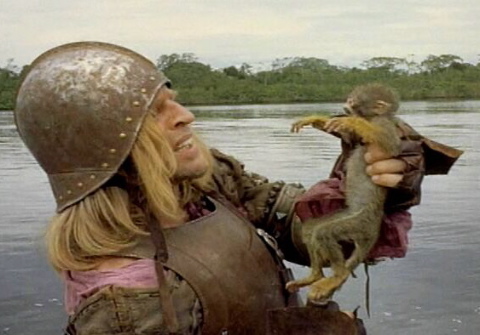
In the last shot, Aquirre is seen walking his crab-like walk on the raft,long lost in wild river waters, still dreaming of the lost city of untold riches. He picks up a monkey murmuring that he is 'The Wrath of God', a ruthless dictator, who is capable of leading the people to El Dorado. But sadly, none in his group is still alive, and it seems unlikely that Aquirre, in his state of frenzied madness, will make it out of the jungle alive.
Herzog, who wrote the screenplay of the movie during the course of a soccer season, freely mixes fact and fiction. He came up with the sparse dialogue for the movie, often only minutes before the shot. When a river swelled flooding the location, he incorporated that into the script.
This is also an independent movie in the truest sense of the term. Herzog made the movie exactly like the way he wanted to, casting his surgeon and even a retarded beggar from the streets in the movie in small roles. The music by Florian Fricke, Herzog's friend, is a combination of natural sounds and instrumental music.
But the most strange thing about the movie, which is full of strange happenings, is Kinski, who must be well over six feet. Kinksi was a friend of Herzog's and the two shared a strained relationship during the shooting.
Kinski, who has a long face and piercing blue eyes, invented a walk - jerks and sideways motions - that is positively scary. He also pretended that one of his arms was shorter than the other, and his costume is strapped to his body in such a way that it looks like he needs it to stay in one piece.
This movie is a series of arresting visuals shot in a documentary style. What makes it great are Herzog's interpretations. Unless you are incredibly sensitive to them, you might miss understanding why this movie is so haunting.

(A movie-length interview that comes with the DVD helps us see the movie from the director's viewpoint. It may not be advisable to see the movie if you don't have the option of watching it once more along with the interview.)

Tuesday, November 21, 2006

Casino Royale: Bond gets real

How difficult was it to reinvent James Bond?

When critics say that Daniel Craig is the best bond since Sean Connery and closest to Ian Fleming’s literary creation, are they reacting to minor changes in the Bond formula? After all, any Bond film made now has to take into account the MI series and the Bourne films, particularly the latter, which seem to have changed action movies forever? And isn’t it time anyone making a Bond movie was influenced by Quentin Tarantino? Or took into account the newfound love for dark movies among both critics and audiences? Now, unlike in the sixties, everyone loves grey; black and white is passé.

But the counter argument is powerful. For 21 official films – Dr No was made in 1962 – and through five Bonds, the franchise remained, at least in its essentials, largely the same. Bond is suave, intelligent, handsome and lethal. Except in the case of Roger Moore, who made Bond silly instead of lethal. He was a delight in his own way, but he played himself instead of Bond. But in the early years of the franchise, it was Connery who enthralled audiences worldwide with his cool smile and smooth talking ways. He was Bond, in all his glory, and those who came after found it hard to replace him. That was the story for all actors who stepped into the Bond shoes.

For me growing up in the 90s, the Bond movies were campy and outdated. Having never witnessed the paranoia of the Cold War, Bond movies seemed to be like a Mediterranean cruise. And Bond always won. And you always knew it. Like the Bard says, the rub always lies in the how.

Golden Eye was the first Bond movie of my time. It reprises all the clichés, the out-of-the-world opening sequence, the two Bond girls, the amazing stunt sequences, the gadgets, the BMW, the globe trotting, and the megalomaniac villain who is out to destroy the world. It smelled like euphoria. But every Bond movie made after that was a disappointment. I wasn’t sure if I had become big or the movies small. But it just wasn’t the same anymore.

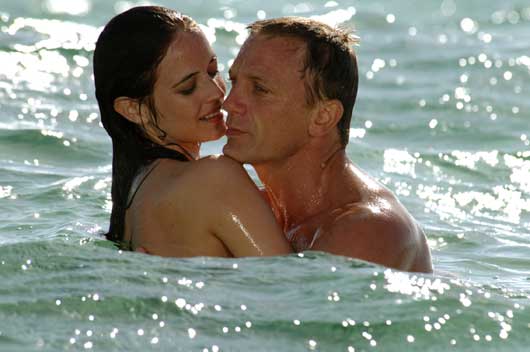
It isn’t the same with Casino Royale too. Bond has been, perhaps, forever changed. First of all he gets real. Then he gets vulnerable and falls in love. He gets beaten up, stabbed and tortured. He has scars on his face, and through the course of a night in a club, his shirt is repeatedly drenched in blood, some of which is his.

The changes begin right from the opening sequence. Instead of the gravity-defying stunt sequence, we see Bond making his first two killings and earning the 007 status. What could have been the opening sequence comes a little later as Bond chases a Black runner through the streets of Madagascar in what must be one of the best Bond chases ever. But this one is on foot.

Later in the movie, there is a car chase. The villains have the Bond girl, played by the dignified, virginal Eva Green. Bond is chasing them in his Aston Martin. Classic Bond scenario. The first Bond chase was in a boat in From Russia, With Love, I think. None of them have ended in an accident. So director Martin Campbell (Golden Eye, Zorro) end this chase in one.

He also does away with Money Penny, the adoring secretary to M, and Q, the gadgetmaker. The famous score doesn’t make an appearance in its entirety till the closing credits. “The name is Bond, James Bond,” is said again only at the end. Ironically, someone else says it before Bond in the movie.

Craig is outstanding in a couple of scenes. In one he is washing away his wounds in front of a hotel room mirror. In another, he almost dies in his favourite car of a cardiac arrest. He plays Bond as a spy instead of a superhero. This is the how-it-all-began story and so all that makes sense.

As the movie unfolded, I realised that Campbell had based the entire movie on the novel. In my teens, I had thought of that as a very boring novel. But that is believed to be Fleming’s best writing. The loyal adaptation works in some cases, and even when it should not work, it does. Like when Bond drinks poison. Everyone in the theatre knows Bond cannot die. But that scene is one of the best of the sort made since Connery beat to death a large spidery creature put in his bed in Dr No. (Wasn’t it?)

Another new thing is the torture sequence adapted from the novel. Bond is stripped bare and tortured in a way that makes Goldfinger look like a wuss. Bond also falls in love, for the last time, with the Eva Green character. He falls, falls hard and learns his lesson. Trust no one.

But again was it so hard to do this? It really wasn’t. But what cannot be explained is how hard it was to reinvent Bond. To make him real, vulnerable, and dark. To put fear, pain and loss in his eyes. That is what is different in this Bond movie. That is why you shouldn’t miss it.

It’s not about how good the movie is. It is about how good it opens up the series for the movies to come.

Read proper reviews here, and here.


********
Time magazine recently listed the 100 best albums of all time. Some of my favourites Graceland and Blonde on Blonde are there.

*********
During the last few days, I wrote three Metblogs. On the Common Entrance Test, Chit Chat, a restaurant, and on the rains. There are more here.

Thursday, November 09, 2006

Blow Up

Watched this movie some three times over the last six months. Pretty awesome. Not the movie, but what directors think audiences are capable of understanding of their work.

David Hemmings stars as a fashion photographer, who accidentally shoots a murder in progress. Michelangelo Antonioni in 1966 was already big enough to make a philosophical inquiry into the nature of reality using this plot, which most other directors would shoot as a thriller.

David - he has no name in the movie, per say - is burning up his life in the swinging, rock 'n' rolling London of the sixties. Movie begins with him leaving a poorhouse, where he has shot people in various poses. He wants to publish these snaps in a book he is working on. In sharp contrast is what he does for a living; he photographs fashion models. In a famous sequence in the film, he shoots supermodel Veruskha, who stars as herself.
David is rich (drives a Rolls Royce), attractive, snobbish and usually gets what he wants. He uses women, but that may not be his worst quality. He absolutely lacks values and we need to get this because when he suspects that a murder has happened he fails to report it.

David runs into a couple in a park. They are hugging and kissing. The women is Vanessa Redgrave. David shoots the couple. She notices him and demands the film and follows him home to get it. David wants to use the snaps for his book. When he develops the film, he finds a murder may have taken place.

This sequence, which about 15-20 minutes long, where he is developing the film in his studio, has no dialogue and is incredible. In a Tamil movie, we would need a Watson to explain what is happening. But here the shots tell the story as David repeatedly blows up the film and suspects he may have shot a gun aiming at someone. But the pictures are grainy and it's hard to tell.

And then the picture unhinges from reality, I think. The rest of it happens in Antonioini's head. As in the logic of it is hard to see for others. And unlike us, who naturally want to find out what happened, Antonioni never lets us know who committed the murder or why.

He is onto things more important. Like if only you have seen something happen and cannot confirm with anyone whether it happened, now did it really happen or not. Like you see a tree, and I say there is no tree, is there really a tree? How much of the nature of reality is understood by social processes?

In the final scene, a group of revellers are playing a tennis match. Only there is no ball. But the group of them are watching the match. Their eyes move along with the ball just like in a tennis match. One of them, hits the ball out of the yard and gestures for David to pick it up. David is first amused and then picks up the imaginary ball and throws it back and now he can actually hear them hitting the ball.

The movie, except for the studio sequence, tests your patience. But it does dig deeper than the usual Hollywood stuff. Watch only if you are the sort to see it again with the commentary. And if you can sit for days afterwards pondering on the nature of reality. Pointless pursuits? Why are they always so darn interesting? Wanna make a movie on that?

Tuesday, November 07, 2006

Great Movies - Roger Ebert

One of the world's most famous film critics chooses the 100 best films of all time. The book is a compilation of his columns written for the Chicago Suntimes. There are no films on the list that are boring, which goes to say a lot about the list. Because if you choose films like Birth of a Nation, which in the 1920s was a landmark film, then you end up making the list very boring. Ebert does well to give those sort of films a miss, carefully choosing movies which are both personal and popular choices. Mr Hulot's Holiday would be a rare example of a totally personal choice.
Ebert also has a prose that is a gift. Most critics writing about film have this high brow style that half the time you don't know what the hell they are talking about. Ebert keeps it simple, straightforward, interesting and gives you all the highlights. He also points out the stuff that is not so obvious.
In a second book, Ebert listed another 100 movies that are a must watch. All the reviews are available online here.

Wednesday, November 01, 2006

Satyajit Ray's Stranger: Stories

Stranger: Stories is a collection of 19 short stories and a short novel by Satyajit Ray. Gopa Majumdar has translated them into English. This is really reading meant for children, but when has that deterred me?
Most of these stories, as Majumdar says, have a supernatural element running through them. Though the stories are not scary, they are filled with strange happenings – hence the name.
The short novel Fotikchand, the story of a kidnapped boy who suffers from amnesia, is perhaps the weakest in the book. Long passages seem to be included in this novel for some strange reason. Perhaps, Ray did not mean for it to be a pure thriller.
The stronger stories have only a few characters and end with a neat twist. But in many stories, characters pop up without any major attempt on the part of the author to provide them with character. Mostly, they are used merely as devices to further the plot.
Many of these stories have children as main characters. Some of these are formulaic – meaning they follow the same path, ending with an inexplicable, mysterious happening, which is often logical only within the premises of the story.
What is appealing is the simplicity of the stories. I wanted them to be complex, but Ray, who was as complex as filmmakers get, shuns this quality as a short story writer. May be he did this because he was writing for children. While this collection acquaints us with Ray’s versatility and interest in various fields, it is not a testimonial to his writing skills.
The story titled Stranger was made into a film Agantuk, Ray’s last.

Wednesday, October 25, 2006

Vallavan: First day, first show

Being a sub is usually a thankless task, a dog’s life actually. No one knows you and you know no one. Unlike reporters, who often bask in the glory of their own stories, subs never get to show off. Once out of office, you are a non-entity. Only your mom knows you.
But if you are a journalist who is into film – this works better if you are a star critic with a big, fat media house – then you get invited to press shows. These are really, really special screenings for the press so that the scribes get to have a go at a movie before everyone else. I think they all get high at the virginal experience.
But Tamil movies – strangely enough – don’t have press shows before movies are open to the public. Sometimes, not always, this is just clever thinking on the part of the studio honchos to pre-empt any negative criticism. Most of the time, it is just darn too inconvenient to have one.

Interlude: Premiers are different from press shows. Premiers are like a costume ball even, where film industry big wigs, journalists and taggers on arrive and flatter each other. I can only speculate because I have never been in one.
There is another variety. This is the preview, which is popular in the west, but I don’t know if it exists here. These guys get to watch the movie or portions of it and crib to the studio executive, who gets the director to tailor the movie according to audience taste. Like a preview viewer (what the heck) can say there is too much blood in this scene to too less. Or this looks too real or this looks fake. Then the executive goes to the director who grumbles and carries grudges around for weeks, but finally does the required cutting and special effects and stuff. Rarely, they even re-shoot. I think Ram Gopal Varma and Priyadarsan should have previews. When you have a lot of spit on your face after the movie is screen, then you bloody well know you made a jackass of everybody.

Coming back to the story: Deprived of press shows, journalists like me get the help of the PROs in theaters. Recently, I reviewed Vallavan for the paper I work in. I booked a ticket but that got cancelled because the show got cancelled.
Oh, wait a minute now. The show was cancelled but it didn’t quite get cancelled. The PRO at Satyam Theatres told me it was cancelled but it wasn’t. The film was screened – true the ‘box’ came late - but my ticket got cancelled. Why, I could never find out. Take a front row ticket or clear off, the guy at the counter told me. He was tense. It was Diwali and the fella was having a tough time.
The movie watching experience itself was great though the movie wasn’t. Nayantara made an appearance - not on screen but in the movie hall - and the audiences went berserk. As the credits rolled, 400 were looking that side and 400 were looking at the exit door where she was standing. Or so I think. I couldn’t really see, though God knows I wanted to. I think I got knocked over. But I wasn't worrying. No, not me. I was thinking: “If somebody had my damn ticket, it better be Nayantara”. It would have been better if she had asked first. But anyways...

I guess that was the high point of the whole affair. I mean at the theatre. After the movie got over, a man in front of me put up his hands up in the classic vote seeking gesture and prayed for mercy. “Kadasiya mudichuttangappaa,” he said, as he was helped out of the theatre.

Oh, I forgot to tell you the story of Muthu, the barber. Muthu, the barber, lives in Medavakkam and gives haircuts for 40 bucks. It’s his own A/C Saloon and he seemed proud of it. He was my movie partner. At least, he was sitting next to me. I first saw him in the counter where he was standing next to me. Try as they might, Satyam can never kill the Q.
Muthu is an Ajith fan. He wanted to see Varalaru, previously called Godfather. Sad for him, no ticket. So after cycling all the way from Medavakkam, he didn’t want to go back. He decided to watch Vallavan. Even worse for him. His life was getting dimmer by the minute.
Somebody had told me, next to Rajni, Ajith has the most loyal fan following in Tamil Nadu. I asked Muthu why he was backing Ajith over Kamal and others. “Kamal irrukkattum sir. Intha pasanga ellam producer, director pasanga. Ajith oruthan than...” At this point, words failed him. I half heard him stifle a cry. He is crying, I thought. Finally, his right thumb extended and swung upwards. “Gun party, sir,” he said, wanting to continue.
(Translation: Ajith was the only guy without previous connections to the industry; somebody who had come up on his own, instead of riding piggyback. Muthu identified with that, I think.)

But then, S.Ve. Shekar appeared on screen and disrupted our most interesting conversation. After that, the lights went off and it was a hellhole for three hours and 10 minutes.

The review of Vallavan is at Desicritics.
P.S: Varalarum sema bladaam. But I haven't seen it yet.

Friday, October 13, 2006

Emtan Mahan - a pleasant drama

I would never have seen this movie in the usual course of things. Except that a friend of mine saw it and liked it and was all praise for Nasser's performance. So I went and saw the movie last weekend.
Thirumurugan who made Metti Oli, a popular serial on Sun TV, is at the helm for this film. Perhaps because of that the movie is like a play. In an industry dominated by technical wizards, movies that absolutely lack any cinematic quality somehow manage to coexist. V.Sekar is another director who makes movies like this, only this one is much better.
SMS Emden is a German ship that attacked the Chennai Port, thereby becoming an euphimism for something terrifying. Emtan in the movie is Nasser, the parochial and dictatorial father, who raises his son in a harsh manner. Roles that risk our antipathy are so hard to play and there is no one better in Tamil cinema than Nasser who knows where the boundary lines for such a role are.
If you really hate the Nasser character in this movie, there is nothing much to watch because it's all about his transformation.
Bharath plays the Mahan - again risky beause he could easily be mistaken for a wimp. But Bharath is good enough to avoid being characterised like that, mixing his fear for his father and a natural heroic tendency in the right proportion. The danger to other actors is Bharath is fast making the boy-next-door image all his. Gopika is pretty and does her bit with ease.
But the star of the show is Vadivelu. Those who hate him better not watch this movie because he is the cohesive element, pasting together all the bits and parts. I wonder if he is in more scenes than Bharath.
I suspect Vadivelu writes his own dialogues because they are so tailormade. That's not to say they are not hilarious - they are.
The story is not new. (Are there any new stories left to tell?) Bharath wants to marry his uncle's daughter and neither the girl's parents nor his own want such a relationship. Nasser is not the sort of father who would hear of the word kaadal in his house and the girl's dad hates Nasser's guts. Much of the first half is spend underlining the strained relationship between Emtan and his Mahan. The second half is the story of the runaway kids and how the boy changes his father. The transformation part - where the main character realises his mistakes - can be a torture and is one in most movies. Here it's more tolerable, thanks to Bharath's and Nasser's subtle acting skills.
Wish it wasn't so much like a play, especially the music, which is ancient. But still it's a pleasant movie to watch.

Monday, October 09, 2006

Hollywood directors I love

This is not a list of directors I admire. That list would be too long. These are the guys who provoke excitement and passion in me for the movies they make. These are the directors I love. So, in no particular order, here is the list:

Ridley Scott
He took horror to space, made a superb science fiction movie, and turned the swords and sandals epic on its head. When Alien was made, Hollywood was just beginning to conquer space and special effects. The film, which straddled the horror and sci-fi genres, was chilling and made Sigourney Weaver an action hero, a poster girl and a feminist icon. Blade Runner had the best sets for a sci-fi movie – created a whole new world for itself. My favourite, though, is Thelma and Louise, a wild chick flick starring Geena Davis and Susan Sarandon. I really loved Geena Davis in this movie.

Steven Spielberg
If Spielberg had died having only made Jaws, E.T. and Jurassic Park, he would still be the most successful moviemaker ever in terms of BO returns. But then he had to go make Saving Private Ryan and Schindler’s List. I actually loved Amistad though it was a horrible flop. Must be the most famous English movie director in India. Even my grandmom can identify him.

Cameron Crowe
Bob Dylan said the liner notes Crowe wrote for Biograph, Dylan’s three-CD collection, were the best part of his album, not the songs like ‘Blowin’ in the Wind’ and ‘Like a Rolling Stone’.Then Crowe made Jerry Macquire, one of funniest and endearing movies I have seen. Endearing usually is a good word for sentimental tearjerkers but Crowe keeps this movie from descending into inanity. But my favourite is Almost Famous, probably the best tribute to Rock music that Hollywood ever made.

Martin Scorcese
Probably the greatest living Hollywood filmmaker. Has combined art house qualities with pure entertainment so effectively that it’s hard to distinguish his somber movies from the fun ones. Taxi Driver, a dark, moody piece, is as entertaining as the Aviator, which was criticized for not confronting Howard Hughes’s dark side. Departed got released this week to good reviews. My favourite: Aviator

Clint Eastwood
A director at the height of his powers, seemingly, all the time. Famous for shooting scenes in a single take, Clint is now working on his most ambitious project yet, Flags of Our Fathers and its companion film, Letters from Iwo Jima. Does anybody realise that Million Dollar Baby is rightfully a sports movie?
My favourite: Unforgiven

David Cronenberg
One movie that really disturbed me in my teens was The Fly. Scenes from this movie would keep playing in my head over and over again. But yet there was this cheesy, B-movie feel to this movie in which the lead character during a transportation experiment transmutes with a fly. My favourite: A History of Violence

Quentin Tarantino
New addition to the brat pack that once was the duo of Spielberg and Lucas. Has made violence of the blood letting kind fashionable, even stylish. Probably one of the most influential filmmakers in the world today. Lately seem to be running on his reserves with Kill Bill garnering mixed reviews. My favourite: Pulp Fiction

Woody Allen
One director who is prolific even if he has made some aweful movies. He may have found his latest muse in Scarlett Johansson. Explored the male-female relationship like no other director. Quintessentially American and funny. His movies are a great PR exercise for the city of New York.
My favourite: Annie Hall

(I did a cursory search for directors I may have missed but didn't find anyone. Who else do you think should have been on the list? The directors you include should have worked for 10 years in Hollywood so that we avoid the one-hit wonders and the newbies. And most importantly, they should be alive.)