Last Saturday, I noticed in the back page of The Economic Times a full page report. This was not a report per say, but the speech of the Chairman of Hindustan Lever Limited.
Two things about this report attracted me. The content of the speech, which talked about brands being at the forefront of social change. How HLL brands like Lifebouy had created a more hygienic society, how Annapurna salt was being used to combat iodine deficiency and so on. In other words, it was about how brands that operate with social consciousness are both successful for the company and society. Even considering the fact that HLL would need the image of being a socially concious company to be successful, the fact that chairman Harish Manwani chose to highlight this in his speech at the Annual General Meeting was impressive.
The other thing that attracted me was the fact that a mainstream newspaper known for its cut throat and often crass commercialism would publish such a speech in its entirety. This may be customary for ET, but this is the first time I have come across such an article, and therefore, I was surprised.
I do think the speech is worthy reading. The speech is a PDF file. I link to the company's homepage from where you can pick the speech up.
Showing posts with label Journalism. Show all posts
Showing posts with label Journalism. Show all posts
Monday, May 21, 2007
Thursday, May 17, 2007
TN's first family slips
 Tamil Nadu has seen an eventful two weeks. On May 9, alleged supporters of M.K. Azhagiri, the chief minister's son, attacked the office of the Dinakaran, which set in motion a clash of two empires - between the clout of a party and a media conglomerate. I imagine people standing in tea shops all across the state breathlessly debating the fate of the state's first family in politics.
The timing of the attack was bad for the DMK. It came on the eve of the celebrations of chief minister M. Karunanidhi's 50 years in the Assembly. Just two days after the attack, UPA's leaders, including Prime Minister Manmohan Singh, Sonia Gandhi, and Laloo Prasad Yadav had to sit a few yards away from the alleged orchestrator of the Madurai violence, M.K. Azhagiri, the chief minister's son.
My friend, who was watching the coverage on Raj TV, which the DMK has said would telecast party programmes in future, remarked: "No wonder Dayanidhi Maran is not on stage today. Azhagiri is sitting with a knife under his belt." He was joking, of course. But that's what most people think of Azhagiri - that he is the black sheep in the MK's family. The actually reason for Maran's absence was that the chief minister had declined to meet him.
It is easy to blow this issue out of proportion, but at the end of the day a few significant things did happen. The DMK has ensured that Maran is thrown out of the prestigious IT and Communication ministry, something that was unimaginable prior to the attack in which two computer engineers and a security guard were killed. It has asked Maran why action should not be taken against him, an allegation that Maran has said hurt him badly.
After holidaying in Ooty for a couple of days, Maran summoned a press conference in Chennai and hit back. He said someone had take advantage of the attack on Dinakaran
to remove him from his post. He clarified that he would never go against the chief minister.
The attack was prompted by a survey jointly done by Dinakaran and AC-Neilson and published in the paper. The survey showed that 70% people favoured M.K.Stalin, the CM's other son and local administration minister, as against only 2% for Azhagiri. There would have been nothing wrong in publishing a survey like that except that Kalanidhi Maran, Dayanidhi's brother, owns both Sun TV and Dinakaran, media organisations that have propped up the DMK in the state.
Even journalists who have condemned the attack would be hard put to see the attack on Dinakaran as an attack on the media. Most have preferred to lay the blame at the door of the Maran brothers, who are also grand nephews of the chief minister.
Was publishing the survey wrong? It's hard to prove that the Marans had political reasons or malicious intent in publishing the survey. It's also hard to ignore the fact that they would not have foreseen that Azhagiri would not be happy in such a survey being published. It is not totally insane to think that the attack was a fallout of party politics and not an attack on the media. I rather prefer to see it that way.
Links between Karunanidhi's family and the Marans have been close and historic. The father Maran, at one point seen as the intellectual face of the organisation, was also its most powerful voice in Delhi's corridors of power. Those comparing the father and the sons often tend to favour the dad, nostalgia weighing in a bit no doubt.
Very few have criticised Azhagiri for the incident. Most people don't want to state the obvious: that this is what is expected of him. That when pushed into a corner he would do what he does best: attack with violent intent.
That there is a successorship issue within the DMK is beyond doubt. There isn't one clear leader emerging from all this glorious mess.
DMK's move to push Kanimozhi's name for the Union commerce ministry would only further mess up the scene. She might enter Parliament through the Rajya Sabha. Radhika Selvi, the wife of Venkatesa Pannayar, has become the minister of state for home. Her elevation in the party is to check actor Sarath Kumar, who hails from the same Nadar caste as the new minister. The action hero, once a rising star in the DMK, in no longer in it. He is likely to launch his own party in August.
The attack has no doubt caused a churning in the DMK. It has drawn into the controversy the names of quite a few primary actors in the party. In the long run, the party might survive all of this as long M. Karunanidhi is at the helm playing his Machiavellian politics. With a twist of this tongue, the chief minister can do away with most nagging problems. Two questions will, however, remain unanswered. Does Dayanidhi Maran have a future in politics? And the question the survey asked - Who after Karunanidhi?
Thursday, December 21, 2006
Randoming again
Another blog about nothing much at all, except my thoughts, which opposite to everything I have learnt in Journalism School, are horizontal rather than vertical - inverted pyramid. This blog, never made public before, is from around the time G.K.Vasan quit as Cong Chief.
Have you ever felt the need to write? Like this bubbling, overflowing feeling that you have to spill your thoughts on paper or in this case onto a blog? What do you do then? Well I, for one, am gonna sit on it. Have a cup of tea, smoke a while. Sleep might come, after all.
What was the lead in the paper last night? EC is trying to get political parties to agree to something very simple: Spent only Rs 25 lakh on a Lok Sabha seat and Rs 10 lakh on a Assembly seat. But parties won't agree. The debate is between whether a cap can be put on how much the candidate spends in addition to what the party spends or just one these. Bigger parties don't want cap on candidate expenditure. The Left, as usual can't agree on what it wants. Nitopal Basu wants a cap and CPI's D. Raja doesn't.
The other major story is that G.K. Vasan is being eased out of the top post in the TN Congress Committee. He is put in charge of the election panel, but an unknown, Krishnaswamy, will head the party in the state. It's tough job, mine, to edit these stories. Because on the above stories, reporters write about 700 words each. Who will read this crap I don't know. For me the story of the day was, a robot named after Philip K Dick, the short story writer, going missing. Now that I will read 200 words on that! On the EC story give me three paras. On G.K.Vasan give me one. I think papers should publish just two pages of news with no pictures. May be a graphic once in a while. Who approves?
*******
I kinda burned out. Will be back. see you after Christmas. BTW, I don't believe in Christianity, but I like Christ. He was a good man. Have you read The Idiot?
Have you ever felt the need to write? Like this bubbling, overflowing feeling that you have to spill your thoughts on paper or in this case onto a blog? What do you do then? Well I, for one, am gonna sit on it. Have a cup of tea, smoke a while. Sleep might come, after all.
What was the lead in the paper last night? EC is trying to get political parties to agree to something very simple: Spent only Rs 25 lakh on a Lok Sabha seat and Rs 10 lakh on a Assembly seat. But parties won't agree. The debate is between whether a cap can be put on how much the candidate spends in addition to what the party spends or just one these. Bigger parties don't want cap on candidate expenditure. The Left, as usual can't agree on what it wants. Nitopal Basu wants a cap and CPI's D. Raja doesn't.
The other major story is that G.K. Vasan is being eased out of the top post in the TN Congress Committee. He is put in charge of the election panel, but an unknown, Krishnaswamy, will head the party in the state. It's tough job, mine, to edit these stories. Because on the above stories, reporters write about 700 words each. Who will read this crap I don't know. For me the story of the day was, a robot named after Philip K Dick, the short story writer, going missing. Now that I will read 200 words on that! On the EC story give me three paras. On G.K.Vasan give me one. I think papers should publish just two pages of news with no pictures. May be a graphic once in a while. Who approves?
*******
I kinda burned out. Will be back. see you after Christmas. BTW, I don't believe in Christianity, but I like Christ. He was a good man. Have you read The Idiot?
Monday, November 20, 2006
A column
A sub-editor has to, without end, develop his skills at work. It's a job filled with pitfalls. But one thing that has really helped me as a sub is the Online and Off Line column that appears in The Hindu every Monday.
The appointment of a readers' editor was highly controversial, with many in the media calling it a dummy post. But I find the column and more than that the daily correction of errors that appears in The Hindu's centre page useful.
Your opinion may differ about how good a job the readers' editor is doing, but try and read the column, particularly if you are a journalist.
The appointment of a readers' editor was highly controversial, with many in the media calling it a dummy post. But I find the column and more than that the daily correction of errors that appears in The Hindu's centre page useful.
Your opinion may differ about how good a job the readers' editor is doing, but try and read the column, particularly if you are a journalist.
Wednesday, November 15, 2006
How I used to write
(Post from a few months ago. Never made public for long. Now will stay here forever)
We came into this world with a mission. Mission to change good things and destroy bad things. Armed with pens and omnipotent power, we write about all things important, newsy or just trivial. Mostly trivial. We make out that we know more than you do. Our word has the power of the print or the electronic waves behind it. It's the gospel truth. We are journalists, seekers of change and courters of controversy.
Not one of us ever doubts his skill, talent or the lack of it. Insecurity is not a feeling that we easily succumb to except when attacked by our own breed. Then we take cover or spew fire.
We are everywhere. At the Tea shop smoking, around the corner from your house, at a crime scene, at speeches, at malls, at events, everywhere. We record everything. Not much escapes us unless delibrately.
We are in the business of deception. Deceiving you into thinking what you read or hear from us is important. Into thinking that you ought not live without us. That you may not crap without a newspaper. But we also make money, at least we ensure that our bosses do. But the deception has to be maintained, of a watchdog, a public servant, of someone whom u can rely on to tell the truth. We speak of ethics while getting drunk in bars. Of patience while chopping off words impatiently. Of clearheadness while writing garbage, day in day out like some stupid cranky machine.
We print and broadcast news, but rarely anything is new. You have already seen and heard it before.
Oh, Why do u need us so? Is it because we tell you that you need us. Is it because we make the dough on how convincing we sound telling you that?
Stop the newspaper. Block the news channels. Dont worry if Atal gets replaced by Manmohan. The rice at the corner shop is Rs 14. You dont need us to tell u that.
We came into this world with a mission. Mission to change good things and destroy bad things. Armed with pens and omnipotent power, we write about all things important, newsy or just trivial. Mostly trivial. We make out that we know more than you do. Our word has the power of the print or the electronic waves behind it. It's the gospel truth. We are journalists, seekers of change and courters of controversy.
Not one of us ever doubts his skill, talent or the lack of it. Insecurity is not a feeling that we easily succumb to except when attacked by our own breed. Then we take cover or spew fire.
We are everywhere. At the Tea shop smoking, around the corner from your house, at a crime scene, at speeches, at malls, at events, everywhere. We record everything. Not much escapes us unless delibrately.
We are in the business of deception. Deceiving you into thinking what you read or hear from us is important. Into thinking that you ought not live without us. That you may not crap without a newspaper. But we also make money, at least we ensure that our bosses do. But the deception has to be maintained, of a watchdog, a public servant, of someone whom u can rely on to tell the truth. We speak of ethics while getting drunk in bars. Of patience while chopping off words impatiently. Of clearheadness while writing garbage, day in day out like some stupid cranky machine.
We print and broadcast news, but rarely anything is new. You have already seen and heard it before.
Oh, Why do u need us so? Is it because we tell you that you need us. Is it because we make the dough on how convincing we sound telling you that?
Stop the newspaper. Block the news channels. Dont worry if Atal gets replaced by Manmohan. The rice at the corner shop is Rs 14. You dont need us to tell u that.
Monday, October 02, 2006
As a journalist
An article in The Times of India attacks bloggers saying that they are writing murders on the web.
"Bloggers claim in their hifalutin tones that they want to give a voice to the voiceless and replace the newspapers with their journalism. It sounds good, but look at the way they are doing this. Their vision is apocalyptic and their language is acidic. It's good fun, but this is no journalism. Learning and mastering good journalism is tough. You learn it in libraries, on flooded streets, in front of a rioting mob, in the middle of crossfire between a militia and a military, in war trenches, in the corridors of power and in the hamlets of deprivation."
Here is the entire thing. And the delicious reply from India Uncut.
And then, there is something from the NYT Public Editor's blog that might interest you. Compare this with what happens at The Hindu here.
"Bloggers claim in their hifalutin tones that they want to give a voice to the voiceless and replace the newspapers with their journalism. It sounds good, but look at the way they are doing this. Their vision is apocalyptic and their language is acidic. It's good fun, but this is no journalism. Learning and mastering good journalism is tough. You learn it in libraries, on flooded streets, in front of a rioting mob, in the middle of crossfire between a militia and a military, in war trenches, in the corridors of power and in the hamlets of deprivation."
Here is the entire thing. And the delicious reply from India Uncut.
And then, there is something from the NYT Public Editor's blog that might interest you. Compare this with what happens at The Hindu here.
Wednesday, May 10, 2006
Fear psychosis among TN govt staff

Government employees in the state, who continue to be haunted by the repercussions of the 2003 strike, are hesitant to vote in the May 8 polls, fearing that they would be victimised by the government that comes to power, a top union official of an employees' association said here.
Pointing to the "vindictive attitude" of the political parties, the union official said a fear psychosis prevails among government employees about taking part in the electoral process.
More than 3.5 lakh government employees are engaged in election duty, often in places faraway from their hometowns. Till now, many of them have frittered away their votes.
"There are two reasons for this. One is that government employees have been deprived of their political rights. They feel that they have no reason to vote. Secondly, the postal ballot system is cumbersome and many feel that it lacks secrecy. There is feeling that the powers that be may come to know for whom the votes were cast," said Mr. Muthu Sundaram, general secretary, Tamil Nadu Government Employees' Association.
Over 1.76 lakh government employees were dismissed invoking an ESMA ordinance after a statewide strike in June-July, 2003. Hearing the case, the Supreme Court, while ruling that government employees had no right to strike, had ordered the state government to reinstate most of the striking employees.
"However, we lost our ability to collectively bargain for better pay or bonus. That was a turning point for us," Mr. Sundaram said. Government employees' unions are mandated by law to be neutral and cannot campaign for a political party, he added.
While such unions maintain neutrality, the statistics available on the 2004 Lok Sabha elections indicate that government employees in large numbers voted against the AIADMK. In many constituencies in which only 100 postal votes had been recorded in earlier elections, the number of votes shot up sharply to 6,000 postal ballots. Much of this was negative voting by government employees against the AIADMK, sources said.
Government employees, in spite of all reservations about the electoral process, continue to be keen about casting their votes during this election. "We have asked the Election Commission to make the process of casting postal ballots easier. We have been assured about the secrecy of our votes and we are keen to cast our ballots," a high-level official of the TN Government Officials' Union said. He said it would be easier for employees to vote if they were engaged in election duty close to their hometowns.
Asked about the perceived lack of interest among government employees to vote, he said, "We are conscious of our democratic duty and are keen to show a better voting record this time around."
Mr. Sundaram called for a better understanding of democracy among government employees. He said he would urge members of his union to actively take part in the elections and fulfill their democratic duty.
Amidst all this, posters depicting the entire strike saga - right from its beginning in June 2, 2003 to the sops announced for government employees in the wake of the 2004 Lok Sabha election results - have been posted at the DMS Complex, Teynampet. The poster allegedly posted on behalf of the government employees recalls the harrowing chain of events and warns that the employees have not forgotten their past. There are also reports of pamphlets being distributed to government employees.
Wednesday, April 19, 2006
Dumbing down
I was watching IBN yesterday afternoon. I must have watched for at least two hours, and three fourths of that was movie and entertainment related news. Why is such stuff forced down our throats, while all that we ask is that the channels, into which hundreds of crores are being pumped into, report the day's news. Honestly, with credibility and without missing any of the major events. The geninue investigative report or the occassional sting operation is quite welcome. But mostly we tune in just to get the day's news. But all we get is bullshit.
Admittedly, IBN does cover hard news in a slightly hysterical fashion in the evening. But through the day, the channel doesnt even do news.
Why can't news channels leave entertainment to the movie channels? Are advertisers dictating this? Or are the viewers not interested in news anymore? Or is it self-imposed by the channel itself?
I think whatever compulsions IBN is facing, it must stop flooding the channel with irrelevant programming and cover the news. People do like to know what is going around them. Mallika Sherawat's curves - well, ya, we are interested in that, but such trivia should not push out the geninue news content.
Even when a major story breaks like Sonia's resignation as MP, the channels just flood viewers with that one news. There is no attempt to recap the day's events quickly and cover the breaking story more aggressively. Which is what they should be doing, dont you think?
When Prannoy Roy began showing World This Week on DD or then tied up with Star, there used to be news on NDTV. But I believe NDTV has also rotted. Thankfully, in CASed Chennai, I am not getting NDTV at home.
I really hope both channels are making a lot of money, because if they aren't there is no point in indulging in this nonsense.
If this isn't dumping down, I don't know what is. I am disgusted, needless to say.
Admittedly, IBN does cover hard news in a slightly hysterical fashion in the evening. But through the day, the channel doesnt even do news.
Why can't news channels leave entertainment to the movie channels? Are advertisers dictating this? Or are the viewers not interested in news anymore? Or is it self-imposed by the channel itself?
I think whatever compulsions IBN is facing, it must stop flooding the channel with irrelevant programming and cover the news. People do like to know what is going around them. Mallika Sherawat's curves - well, ya, we are interested in that, but such trivia should not push out the geninue news content.
Even when a major story breaks like Sonia's resignation as MP, the channels just flood viewers with that one news. There is no attempt to recap the day's events quickly and cover the breaking story more aggressively. Which is what they should be doing, dont you think?
When Prannoy Roy began showing World This Week on DD or then tied up with Star, there used to be news on NDTV. But I believe NDTV has also rotted. Thankfully, in CASed Chennai, I am not getting NDTV at home.
I really hope both channels are making a lot of money, because if they aren't there is no point in indulging in this nonsense.
If this isn't dumping down, I don't know what is. I am disgusted, needless to say.
Tuesday, April 18, 2006
Graveyard Shift
Reprobate, owner of a particularly messy blog, has towards the end of March written on a term that is quite familiar for journalists - The Graveyard Shift. I am on one this week, after quite a while. I moved jobs recently and have been put on this dreadful shift for the first time. Yesterday, a couple of fellas on the sports desk decided to stay back. So the loneliness didnt quite get to me. Today, they disappeared and I am sitting here, listening to Dylan's tribute to Woody Guthrie, and it is quite depressing - the working in the night business not the song.
My office consists of just three floors and most of it is taken up by this huge Rs 40-crore printing machine, which churns out three lakh issues in about three hours or so. The rest of it is office space and the editorial is this large hall, full of cubicles. Inhuman, I say. It's a bit like being in a factory; your only friend is your computer. The fella in the next cubicle often exchanges only ten words with you the entire day.
I used to enjoy working in the night. It's anti-social, against the grain, and is everything I value in life. I can sit alone, and work on anything I want, read the whole night, watch three movies, do anything I want. But after doing this for about three years in a row, I am sick and tired of it. I wanna a day job. Nine to Fiver- like in a bank. Doing something that is even more pointless than this.
I have rarely rambled on my blog. But here is how is sound when I ramble. Tune off, if you dont like it.
My office consists of just three floors and most of it is taken up by this huge Rs 40-crore printing machine, which churns out three lakh issues in about three hours or so. The rest of it is office space and the editorial is this large hall, full of cubicles. Inhuman, I say. It's a bit like being in a factory; your only friend is your computer. The fella in the next cubicle often exchanges only ten words with you the entire day.
I used to enjoy working in the night. It's anti-social, against the grain, and is everything I value in life. I can sit alone, and work on anything I want, read the whole night, watch three movies, do anything I want. But after doing this for about three years in a row, I am sick and tired of it. I wanna a day job. Nine to Fiver- like in a bank. Doing something that is even more pointless than this.
I have rarely rambled on my blog. But here is how is sound when I ramble. Tune off, if you dont like it.
Friday, March 24, 2006
Student Violence
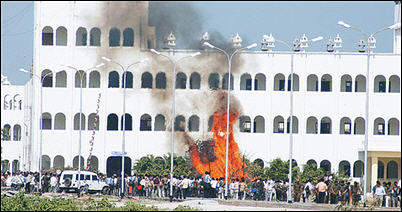 The student unrest in Sathyabhama University on the Old Mahabhalipuram Road in Chennai has shut the varsity down indefinitely causing concern among students over whether the semester examinations that are to begin on April 17 will be held.
Students of the deemed university - many of them who plan to go abroad after their engineering studies - fear that their examinations may not be held on time this year. Students have gone on a rampage at the varsity’s campus thrice since March 1, when violence first broke out.
After that instances of violence were repeated on March 22 and 23, when the management finally decided to close down the University.
At the heart of the differences between the students and the management is the lack of approval by the All-India Institute of Technical Education (AICTE) to the courses offered by Sathyabhama University. The management contends that it is a deemed university and, therefore, does not need AICTE approval, while students fear that the lack of recognition would hamper their careers.
On March 23, the students went on an unprecedented rampage, burning down an open-air auditorium at the campus and wrecking the classrooms and laboratories. Students allege that the authoritarian regime at the college is also one of the reasons for the violence. Sources said that often girls and boys are prevented from talking to one another at the co-education varsity.
Students have also alleged that the management is ruthlessly trying to suppress the unrest by hiring goondas and dividing the students along regional lines. They said the management should try and resolve their problems instead of suppressing the protests. Many students have started leaving their hostels fearing further violence.
On news channels, the faces of students being interviewed are being masked, leading to fears that the university management may take extreme steps in putting the issue to rest. A CNN-IBN report mentioned that its cameraman at the scene was attacked and his videotape burned.
Violence has also broken out at the SRM Institute of Science and Technology, another deemed university. Students and the police clashed at this college campus too on March 1.
Meanwhile, the first bench of the Madras High Court on Friday advised the students to give up the violence. They have also observed that even deemed universities have to observe AICTE norms while posting further hearing in the case for April 3. The bench, also comprising the Chief Justice A.P. Shah, was hearing a batch of writ petitions and PILs filed on the issue.
The Students Federation of India (SFI) and All India Students Federation have decided to back the students. The SFI has demanded that the University Chancellor Jeppiar, a famous Chennai-based educationist, be arrested. The students’ body has also impleaded itself in the case being heard in the Madras High Court.
Dreamchaser has been avidly blogging on the issue. Click here to read his blog.
Wednesday, March 15, 2006
TN Poll Masala
I have been writing for about three months on my blog now. The highest amount of hits - I recently found out how to track this - was on the day Vaiko shifted camps and I blogged this. I got 96 visitors that day, the highest on my site so far. Cheers, guys.
The seating sharing within the Democratic Progressive Alliance (DPA), the main Opposition coalition in Tamil Nadu is over, for the large part at least. A few wrinkled need to ironed out. CPI has some grouches about it getting fewer seats than the CPM. Also, the fate of INTUC, the trade union wing of the Congress party, is ambivalent. There appears to be split that Chief Minister J Jayalalithaa has engineered within the INTUC. The rebel group has announced that it will support Amma's AIADMK.
The elections will be notified on April 13 and campaign, which has already begun, will really go into high gear after that.
I was surprised to learn that contrary to what I had said in my post on Vaiko, AIADMK does stand a good chance of winning. The last three elections having witnessed a sweep against one Dravidian party or the other, poll pundits are predicting another sweep. I am not sure if really AIADMK can win with such a weak coalition.
AIADMK swept to power in 1991 after former Prime Minister Rajiv Gandhi's assassination and reports of DMK's alleged hand in it. DMK hit back with equal vigour in 1996, the sweep coming in the face of a widespread scandal over Amma's corrupt ways and the massive amount of money she had spent on marrying off her adopted son. In the absence of any major such reasons, AIADMK swept back to power in great style in 2001 even as legal questions hampered Jaya's quest for the CM's chair.
Will there be yet another sweep? Do the people of Tamil Nadu have an overwhelming need for change. Has anything really happened to boost Amma's chances of retaining power since it lost all the 39 Lok Sabha seats in the last parliamentary elections to the DMK-led alliance?
Two things of some significance of indeed happened. One, Veerappan was shot dead and two, Sankaracharya was arrested and is being tried in court.
Also prior to the elections, Jayalalithaa has rolled back many of the stringent measures she had imposed on the people. A source said that she is willing to pump in Rs 300 crore to win this election. Will she be able to do it with only Vaiko and Thirumavalavan on her side? That's the question that will and can be answered even as the campaign begins. Right now, people don't know which way they are going to vote. Not yet. Let the policians start gunning and then we will know for sure.
The seating sharing within the Democratic Progressive Alliance (DPA), the main Opposition coalition in Tamil Nadu is over, for the large part at least. A few wrinkled need to ironed out. CPI has some grouches about it getting fewer seats than the CPM. Also, the fate of INTUC, the trade union wing of the Congress party, is ambivalent. There appears to be split that Chief Minister J Jayalalithaa has engineered within the INTUC. The rebel group has announced that it will support Amma's AIADMK.
The elections will be notified on April 13 and campaign, which has already begun, will really go into high gear after that.
I was surprised to learn that contrary to what I had said in my post on Vaiko, AIADMK does stand a good chance of winning. The last three elections having witnessed a sweep against one Dravidian party or the other, poll pundits are predicting another sweep. I am not sure if really AIADMK can win with such a weak coalition.
AIADMK swept to power in 1991 after former Prime Minister Rajiv Gandhi's assassination and reports of DMK's alleged hand in it. DMK hit back with equal vigour in 1996, the sweep coming in the face of a widespread scandal over Amma's corrupt ways and the massive amount of money she had spent on marrying off her adopted son. In the absence of any major such reasons, AIADMK swept back to power in great style in 2001 even as legal questions hampered Jaya's quest for the CM's chair.
Will there be yet another sweep? Do the people of Tamil Nadu have an overwhelming need for change. Has anything really happened to boost Amma's chances of retaining power since it lost all the 39 Lok Sabha seats in the last parliamentary elections to the DMK-led alliance?
Two things of some significance of indeed happened. One, Veerappan was shot dead and two, Sankaracharya was arrested and is being tried in court.
Also prior to the elections, Jayalalithaa has rolled back many of the stringent measures she had imposed on the people. A source said that she is willing to pump in Rs 300 crore to win this election. Will she be able to do it with only Vaiko and Thirumavalavan on her side? That's the question that will and can be answered even as the campaign begins. Right now, people don't know which way they are going to vote. Not yet. Let the policians start gunning and then we will know for sure.
Saturday, March 04, 2006
First strike: Vaiko

The finest hour in Tamil Nadu politics: Jayalalithaa
We were humiliated
by the DMK: Vaiko
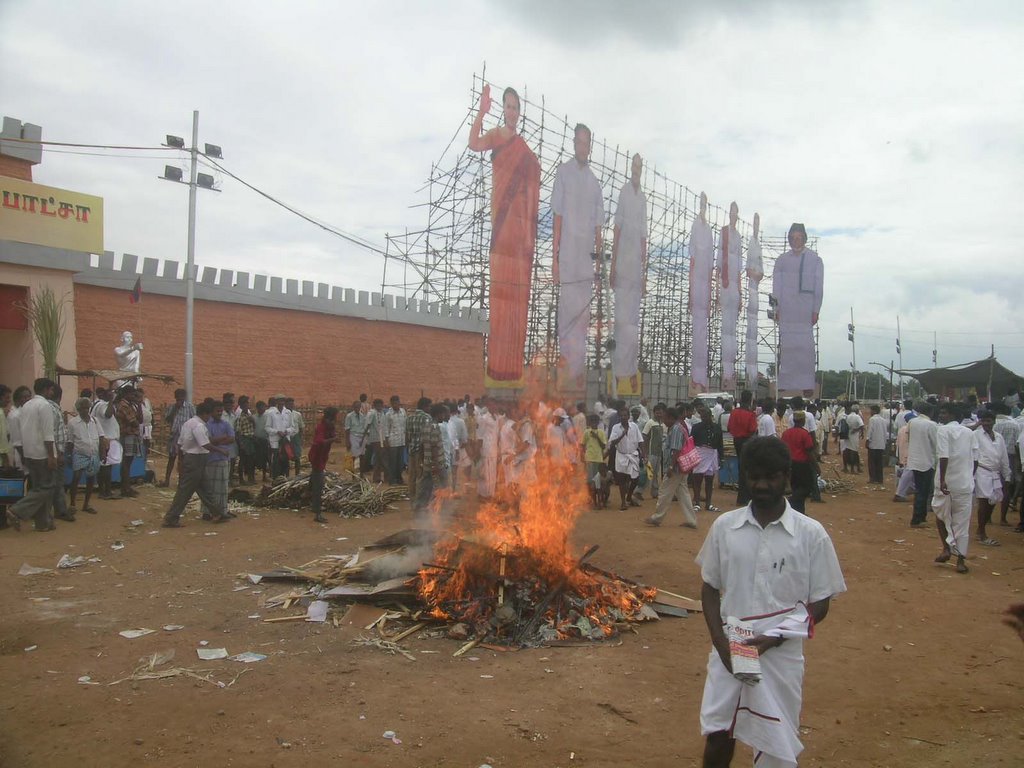
Furious DMK cadres burning a huge effigy of Vaiko after he decided to have an ``electoral alliance'' (read not an idealogical alliance) with the AIADMK
A suitable ally?
This should be filed under mindspace in my blog, cause there is really no space for politics. This will be my first political blog. May be I will blog the entire elections. Watch out guys.
 The Marumalarchi Dravida Munnetra Kazhagam (MDMK) on March 4 (Saturday) decided to leave the Democratic Progressive Alliance (DPA), the main Opposition in Tamil Nadu, and join hands with Chief Minister J Jayalalithaa's AIADMK to fight the upcoming elections.
The elections, scheduled for May 8, will be a fight between the two Dravidian parties - Karunanidhi's DMK and the AIADMK. Vaiko's u-turn, after he asserted last week that he will not quit the DPA and UPA at the Centre, came a day after Karunanidhi offered the MDMK leader 22 seats to contest in 234-member Tamil Nadu Assembly. Vaiko has asked that 25 seats be given to his party, Karunanidhi said at his party's statewide conference in Tiruchy.
At first glance, Vaiko's disgust for DMK's high handedness seems justified.
The fate of the two national parties is already known. The Congress, which has a marginal presence in Tamil Nadu and a new state president, will remain with the DPA. The Bharatiya Janata Party (BJP) is likely to go it alone as it had already announced earlier.
Vaiko's decision comes in the same week as Dalit Panthers of India (DPI) leader Tirumavalan's move to join hands with Jaya.
The MDMK and AIADMK are now left with the difficult task of explaining to the people and to their party cadre why Vaiko's arrest under POTA for his alleged pro-LTTE speaches is suddenly a non-issue. Just how Vaiko will explain this bizarre but expected turn of events is still unclear.
Meanwhile, the election promises to be viciously fought. Vaiko's arrest under POTA, Karunanidhi's midnight arrest, the TN government's efforts to provide relief to the Tsunami affected and the widespread criticism against this, the flood relief effort and the all too avoidable stampede in a Chennai school, all seem irrelevant now.
This election seems to based on pure maths rather than anything else. And if DMK carries the rest of the alliance with it even after the seat sharing charade ends, then it looks to me that the DPA would win.
I would not like to underestimate Jaya, but the difference between getting 25% of the votes and 35%, which would ensure a certain victory is all important. And Jaya has only Tiruvamalavan and Vaiko on her side now. The BJP may choose to go in for a last minute tie-up with Jaya. When campaigning begins much of what I said will be forgotten and a lot more will be dug up.
By enacting the Bill to take over SCV and Hathway, Jaya has ensured that this election is going to be vicious. A couple days later after the Bill was passed in the Assembly, Stalin and thousands of DMK men were arrested.
Jaya, traditionally thought to be the more corrupt of the Dravidian leaders, is also the more efficient. Her rule between 1991-96 and the present term have both been a flourishing period for the TN economy.
It's doubtful if the DMK, burdened by the presence of the Left and its own tendencies, will be able to continue from where Jaya leaves the state. I don't see how an alliance with PMK's S. Ramadoss and Nallakannu in it can push through economic reforms.
Also, mention must be made of the bungling over the conduct of the Common Entrance Test, which the High Court (HC) deemed mandatory after Jaya struck it down. The TN government now plans to take it to the Supreme Court (SC). Already, students in two well-known and reputed engineering colleges have gone on a rampage, smashing things up at their college. I really can't say if it will affect polls or not, but aren't students a big vote bank as well?
As the polls draw closer, the media, I expect, will begin to put out what it has already realised: only a last minute miracle from Jaya can hamper a DMK victory. Or is the poll still too close to call? The media will keep saying that the polls are being closely fought, particularly the English media, even if it's only to keep a largely uninterested middle class involved in the poll tamasha.
Kalanidhi Maran launched an evening daily Malai Murasu a year back and in the light of its huge success, revamped Dinakaran. This morning daily was launched last week, amid quite a bit of hype and both papers will throw their weight behind DMK. They have already earned a place in the Tamil media as being non-party papers, which means they are being read by people outside the party as well. Murasoli will now toe the DMK line as it has always done.
The Pattali Makkal Katchi (PMK) plans to launch a mainstream Tamil newspaper. With Dinkaran being re-launched just last week, the print wars are expected to begin in earnest ahead of the polls.
Meanwhile, look at what Harsha had to say just a few months ago. Seems to be still relevant. Also, read what he had to say on the day the story broke.
 Something on the media front: The Pattali Makkal Katchi, headed by Ramdoss whose son Anbumani is the Union Health Minister, is to launch a mainstream Tamil newspaper. With Sun group's Dinkaran being launched just last week, the print wars are expected to begin in earnest ahead of the polls.
 The Marumalarchi Dravida Munnetra Kazhagam (MDMK) on March 4 (Saturday) decided to leave the Democratic Progressive Alliance (DPA), the main Opposition in Tamil Nadu, and join hands with Chief Minister J Jayalalithaa's AIADMK to fight the upcoming elections.
The elections, scheduled for May 8, will be a fight between the two Dravidian parties - Karunanidhi's DMK and the AIADMK. Vaiko's u-turn, after he asserted last week that he will not quit the DPA and UPA at the Centre, came a day after Karunanidhi offered the MDMK leader 22 seats to contest in 234-member Tamil Nadu Assembly. Vaiko has asked that 25 seats be given to his party, Karunanidhi said at his party's statewide conference in Tiruchy.
At first glance, Vaiko's disgust for DMK's high handedness seems justified.
The fate of the two national parties is already known. The Congress, which has a marginal presence in Tamil Nadu and a new state president, will remain with the DPA. The Bharatiya Janata Party (BJP) is likely to go it alone as it had already announced earlier.
Vaiko's decision comes in the same week as Dalit Panthers of India (DPI) leader Tirumavalan's move to join hands with Jaya.
The MDMK and AIADMK are now left with the difficult task of explaining to the people and to their party cadre why Vaiko's arrest under POTA for his alleged pro-LTTE speaches is suddenly a non-issue. Just how Vaiko will explain this bizarre but expected turn of events is still unclear.
Meanwhile, the election promises to be viciously fought. Vaiko's arrest under POTA, Karunanidhi's midnight arrest, the TN government's efforts to provide relief to the Tsunami affected and the widespread criticism against this, the flood relief effort and the all too avoidable stampede in a Chennai school, all seem irrelevant now.
This election seems to based on pure maths rather than anything else. And if DMK carries the rest of the alliance with it even after the seat sharing charade ends, then it looks to me that the DPA would win.
I would not like to underestimate Jaya, but the difference between getting 25% of the votes and 35%, which would ensure a certain victory is all important. And Jaya has only Tiruvamalavan and Vaiko on her side now. The BJP may choose to go in for a last minute tie-up with Jaya. When campaigning begins much of what I said will be forgotten and a lot more will be dug up.
By enacting the Bill to take over SCV and Hathway, Jaya has ensured that this election is going to be vicious. A couple days later after the Bill was passed in the Assembly, Stalin and thousands of DMK men were arrested.
Jaya, traditionally thought to be the more corrupt of the Dravidian leaders, is also the more efficient. Her rule between 1991-96 and the present term have both been a flourishing period for the TN economy.
It's doubtful if the DMK, burdened by the presence of the Left and its own tendencies, will be able to continue from where Jaya leaves the state. I don't see how an alliance with PMK's S. Ramadoss and Nallakannu in it can push through economic reforms.
Also, mention must be made of the bungling over the conduct of the Common Entrance Test, which the High Court (HC) deemed mandatory after Jaya struck it down. The TN government now plans to take it to the Supreme Court (SC). Already, students in two well-known and reputed engineering colleges have gone on a rampage, smashing things up at their college. I really can't say if it will affect polls or not, but aren't students a big vote bank as well?
As the polls draw closer, the media, I expect, will begin to put out what it has already realised: only a last minute miracle from Jaya can hamper a DMK victory. Or is the poll still too close to call? The media will keep saying that the polls are being closely fought, particularly the English media, even if it's only to keep a largely uninterested middle class involved in the poll tamasha.
Kalanidhi Maran launched an evening daily Malai Murasu a year back and in the light of its huge success, revamped Dinakaran. This morning daily was launched last week, amid quite a bit of hype and both papers will throw their weight behind DMK. They have already earned a place in the Tamil media as being non-party papers, which means they are being read by people outside the party as well. Murasoli will now toe the DMK line as it has always done.
The Pattali Makkal Katchi (PMK) plans to launch a mainstream Tamil newspaper. With Dinkaran being re-launched just last week, the print wars are expected to begin in earnest ahead of the polls.
Meanwhile, look at what Harsha had to say just a few months ago. Seems to be still relevant. Also, read what he had to say on the day the story broke.
 Something on the media front: The Pattali Makkal Katchi, headed by Ramdoss whose son Anbumani is the Union Health Minister, is to launch a mainstream Tamil newspaper. With Sun group's Dinkaran being launched just last week, the print wars are expected to begin in earnest ahead of the polls.
Thursday, February 16, 2006
Upakathai
`Upakathai', a five-act play, is a set of stories from the Mahabharata, Ramayana, the Mughal period, the Vedas and a modern tale of classroom woes created by playwright Pralayan. A single thread runs through all these tales. All of them are of a victim and are told from a victim's point of view.The first of these is of Ekalavyan, the mythological ruler of Nishad in the Mahabharata. Vyasa's version is that Ekalavyan, the tribal king of Nishad, after a showdown with Pandava prince Arjuna, cuts off his own thumb as a sacrificial act for his guru Dronacharya.
Prayalan inverts this myth in the first act and then uses Ekalavyan in the rest of the play as a surrealistic narrator, sending him back and forth in time, from the Ramayana to the modern era and back to the Vedic period.The playwright doesn't show much respect for either mythology or history, but has a rich knowledge of their intricacies. He blatantly and brilliantly changes each myth and tailors it to suit his theme of Dalit oppression.Pralayan's stripped-down, on-your-face direction suffers from over-exposition, but makes sure that every single soul in the audience understands this complex story. His protoganist, Ekalavyan, meticulously explains each detail of the text and warns the audience of impending changes in the time period to ensure comprehension.
The first act is a Dalit take on a Mahabharata`upakathai'. Arjuna after suffering defeat at the hands of Ekalavyan, returns with his guru Dronacharya, who threatens that Nishad will be razed and its tribal population exterminated. To save the people, Ekalavyan lets Arjuna cut off his thumb. An anonymous character accuses Ekalavyan of changing the popular myth. ``Everyone knows that you gave up your thumb for your guru to please him. Now, you are changing the story to reflect your needs. These changes are outrageous. Who would believe that you defeated Arjuna, the famous warrior and Pandava prince?''Ekalvyan, however, insists that his story is the truth. ``The victors gave their version. I have given mine. I am not Vyasa to tell the story in a way that does not shock you,'' he replies.Inversion of popular myths are not new to Tamil literature or art. Puthumaipithan (1902-1948) had established this as an art form in his lifetime. The genius in this play lies in the eclectic and heady mixture of mythology, history and modernity that the playwright brings to his theme.In the next act, Rama, helpless and lonely after sending Sita into exile, is led into believing that he must kill a lower caste boy to prevent him from learning the Vedas, a right which only Brahmins enjoy. ``I murdered Taraka because sage Vishwamitra asked me to. Then Sugrivan asked me to kill Vali. Up to this day, I have not done anything for myself. Now, you my ministers, are asking me to kill Sampoka,'' the king says. In thus mocking Rama, the playwright is savagely destroying ``images of the golden period of the Ram Rajya.''The hero has been made the villain, his murderous act is one of meaningless vengence to preseve caste heirarchy.The next act, which jumps a few centuries forward in time, is perhaps the weakest. This is the when the play gets a bit contrived and sentimental. Set in the modern period, this is a parody of the education system, and like all good parodies hits straight at the truth. The hero of this act, a Dalit boy, is a budding poet and painter in his school. But his talents go wasted in a school that confines itself to the textbooks.The next tale is of the Mughal prince Salim's love for court dancer Anarkali. Ultimately, despite Akbar's misgivings, she too is beheaded.Salim's mother was a Hindu Rajputan queen. When Salim points this out to Anarkali, the court dancer replies that Hindustan may tolerate a Muslim Emperor marrying a Rajputan, but won't allow a marriage between her and the prince. The playwright rightly points out through this story that the difference between Salim and Anarkali is one of``caste''. Caste divisions till today dominate over religious differences, he points out.In the fifth and final act, Renuka finds herself with a upper caste head and lower caste body after she is first killed and then brought back to life by her son.The play was performed by the Chennai Kalai Kuzhu, an amatuer group of 40 players, some of them very new and, therefore, under rehearsed. The stage, sparsely lit, had a superb and unusual backdrop, a lit tree.Right from the beginning, the play is moving.
In the first act, when a furious Drona arrives at Nishad, he finds every tribal willing to give up his life for their king Ekalavyan. Later, Parasurama, in a emotional moment, says, ``Father, this is not some woman you are asking me to kill. This is my mother.''There was irony in that fact that these dialogues - deceptively simple and deliberately overwritten - were delivered in traditional Tamil theatre style, while the content of the play itself was anything but traditional.This is a play with a hard-hitting political message that uses the art of the theatre to convey it. As a playwright, Pralayan, well-known for his street plays in Chennai, is probably incapable of creating art without politics.
Staged with very few props and almost ``devoid of stylistic and illusory devices,'' the play is a testimony to the power of the theatre and a reiteration of its relevance during the age of the TV and cinema.Everyone in the audience - over 1,000 of them - understood the story, going by the laughs and claps. A few kids were seen enjoying every bit of it.Though this is a play heavily dependent on dialogue, its visuals are also extraordinary. The stage is divided into two - the lower level a few feet above ground and the upper level, an eight-feet tallplatform. The upper level is for what the playwright calls his ``heirarchy characters'' and another for the lower castes and ordinary people. Rama, Akbar, Arjuna, Drona, the school headmistress and drill master appear either on the upper level or are carried on stage in a moving platform. All the victims appear on the lower level.By inverting existing myths, historical and modern narratives in favour of the Dalits, the playwright is in way empowering them. Instead of the Khastriya Prince Arjuna, the tribal warrior Ekalavyan is here their hero who speaks in their voice. The sham as old as Hindu civilisation itself stands exposed. Conventions shatter, images crumble and out of it the Dalit voice is finally heard.
`Upakathai', written and directed by Pralayan, was staged during the 10th state-wide conference of the Tamil Nadu Progressive Writers Association on the eve of Gandhi Jayanthi at the Danish Mission School in Tiruvannamalai.
Prayalan inverts this myth in the first act and then uses Ekalavyan in the rest of the play as a surrealistic narrator, sending him back and forth in time, from the Ramayana to the modern era and back to the Vedic period.The playwright doesn't show much respect for either mythology or history, but has a rich knowledge of their intricacies. He blatantly and brilliantly changes each myth and tailors it to suit his theme of Dalit oppression.Pralayan's stripped-down, on-your-face direction suffers from over-exposition, but makes sure that every single soul in the audience understands this complex story. His protoganist, Ekalavyan, meticulously explains each detail of the text and warns the audience of impending changes in the time period to ensure comprehension.
The first act is a Dalit take on a Mahabharata`upakathai'. Arjuna after suffering defeat at the hands of Ekalavyan, returns with his guru Dronacharya, who threatens that Nishad will be razed and its tribal population exterminated. To save the people, Ekalavyan lets Arjuna cut off his thumb. An anonymous character accuses Ekalavyan of changing the popular myth. ``Everyone knows that you gave up your thumb for your guru to please him. Now, you are changing the story to reflect your needs. These changes are outrageous. Who would believe that you defeated Arjuna, the famous warrior and Pandava prince?''Ekalvyan, however, insists that his story is the truth. ``The victors gave their version. I have given mine. I am not Vyasa to tell the story in a way that does not shock you,'' he replies.Inversion of popular myths are not new to Tamil literature or art. Puthumaipithan (1902-1948) had established this as an art form in his lifetime. The genius in this play lies in the eclectic and heady mixture of mythology, history and modernity that the playwright brings to his theme.In the next act, Rama, helpless and lonely after sending Sita into exile, is led into believing that he must kill a lower caste boy to prevent him from learning the Vedas, a right which only Brahmins enjoy. ``I murdered Taraka because sage Vishwamitra asked me to. Then Sugrivan asked me to kill Vali. Up to this day, I have not done anything for myself. Now, you my ministers, are asking me to kill Sampoka,'' the king says. In thus mocking Rama, the playwright is savagely destroying ``images of the golden period of the Ram Rajya.''The hero has been made the villain, his murderous act is one of meaningless vengence to preseve caste heirarchy.The next act, which jumps a few centuries forward in time, is perhaps the weakest. This is the when the play gets a bit contrived and sentimental. Set in the modern period, this is a parody of the education system, and like all good parodies hits straight at the truth. The hero of this act, a Dalit boy, is a budding poet and painter in his school. But his talents go wasted in a school that confines itself to the textbooks.The next tale is of the Mughal prince Salim's love for court dancer Anarkali. Ultimately, despite Akbar's misgivings, she too is beheaded.Salim's mother was a Hindu Rajputan queen. When Salim points this out to Anarkali, the court dancer replies that Hindustan may tolerate a Muslim Emperor marrying a Rajputan, but won't allow a marriage between her and the prince. The playwright rightly points out through this story that the difference between Salim and Anarkali is one of``caste''. Caste divisions till today dominate over religious differences, he points out.In the fifth and final act, Renuka finds herself with a upper caste head and lower caste body after she is first killed and then brought back to life by her son.The play was performed by the Chennai Kalai Kuzhu, an amatuer group of 40 players, some of them very new and, therefore, under rehearsed. The stage, sparsely lit, had a superb and unusual backdrop, a lit tree.Right from the beginning, the play is moving.
In the first act, when a furious Drona arrives at Nishad, he finds every tribal willing to give up his life for their king Ekalavyan. Later, Parasurama, in a emotional moment, says, ``Father, this is not some woman you are asking me to kill. This is my mother.''There was irony in that fact that these dialogues - deceptively simple and deliberately overwritten - were delivered in traditional Tamil theatre style, while the content of the play itself was anything but traditional.This is a play with a hard-hitting political message that uses the art of the theatre to convey it. As a playwright, Pralayan, well-known for his street plays in Chennai, is probably incapable of creating art without politics.
Staged with very few props and almost ``devoid of stylistic and illusory devices,'' the play is a testimony to the power of the theatre and a reiteration of its relevance during the age of the TV and cinema.Everyone in the audience - over 1,000 of them - understood the story, going by the laughs and claps. A few kids were seen enjoying every bit of it.Though this is a play heavily dependent on dialogue, its visuals are also extraordinary. The stage is divided into two - the lower level a few feet above ground and the upper level, an eight-feet tallplatform. The upper level is for what the playwright calls his ``heirarchy characters'' and another for the lower castes and ordinary people. Rama, Akbar, Arjuna, Drona, the school headmistress and drill master appear either on the upper level or are carried on stage in a moving platform. All the victims appear on the lower level.By inverting existing myths, historical and modern narratives in favour of the Dalits, the playwright is in way empowering them. Instead of the Khastriya Prince Arjuna, the tribal warrior Ekalavyan is here their hero who speaks in their voice. The sham as old as Hindu civilisation itself stands exposed. Conventions shatter, images crumble and out of it the Dalit voice is finally heard.
`Upakathai', written and directed by Pralayan, was staged during the 10th state-wide conference of the Tamil Nadu Progressive Writers Association on the eve of Gandhi Jayanthi at the Danish Mission School in Tiruvannamalai.
Cultural Churning
Tiruvannamalai, Oct 1: More than 20,000 people from Tiruvannamalai and its surrounding areas are expected to attend the all-night cultural festival on Sunday night. The festival, which will conclude the 10th state-wide conference of the Tamil Nadu Progressive Writers Association (TPWA), has nowadays become a much-awaited event.
An eclectic mixture of speeches, modern plays, folk songs, book release functions and short films, the all-night culturals have captured the hearts and minds of the people of this region.
Two of the architects of the festival – BaVa Chelladurai and Karuna who have been active writers with the TPWA - spoke to *Express* today. Both writers are immensely proud of their achievements in Tiruvannamalai, the influence the cultural night enjoys within the TPWA and the impact it has had on the people. They recalled that the first of the all-night events held in 1985 had attracted just 50 people. The next year, the organisers had miraculously managed to attract 10,000 people.
``We tell the people about issues that affect their lives. We avoid events that trivialise art and are purely commercial in nature. People are aware that this is serious stuff and are attracted to it,’’ Karuna, the treasurer of the reception committee for this year’s conference, said.
The event is funded at the grassroots level. On September 4, about 400 progressive writers met here, divided themselves into small groups, and spread out into the town. Knocking on each door, these groups managed to collect Rs 60,000 this year. Small merchants in the area too contributed, some of them up to Rs 10,000. ``This is not a big industrial area. Getting corporate sponsors is out of question,’’ Karuna said. ``People who contribute know that the money will be put to good use,’’ he added.
``The all-night events used to be conducted on New Year’s Eve. Dalit art forms take precedence over others,’’ BaVa, secretary of the reception committee, said. BaVa’s infectious enthusiasm and boundless energy must have been a driving force behind this conference. Virtually his whole life has been shaped by the cultural nights. He said he had met his wife Shailaja, also a writer who has translated works from Malayalam to Tamil. Years later, he lost his only son during another cultural night.
Also born out of the cultural churning was the concept of *Muttram*. Tamil writers such as Jayakanthan, Sundara Ramaswamy, P. Kandasamy and T. Rajanarayanan are among the past invitees to *Muttram*, where they sit as one with the audience and share their ideas, views and inspirations. Then ``running out of Tamil writers’’, the organisers began inviting writers from outside the state. Noted Malayalam writers K Sachidanandan, Balachandran Chullikadu and K.N. Panniker, and Paul Zacharia have also taken part in this programme.
``Many of these writers have nothing to do with TPWA. However, we are able to persuade them to come and share their ideas,’’ Karuna said.
``The posters and banners that we put up for the events are quite famous. Artists like Trosky Marudu and Aadimoolam have helped us immensely by creatively designing these posters,’’ BaVa said. Karuna himself has designed the posters this year.
Books of writers such as Jayamohan and Konangi have been released during these cultural nights. This year’s cultural night is being presided over by Pralayan, playwright and street theater actor.
An eclectic mixture of speeches, modern plays, folk songs, book release functions and short films, the all-night culturals have captured the hearts and minds of the people of this region.
Two of the architects of the festival – BaVa Chelladurai and Karuna who have been active writers with the TPWA - spoke to *Express* today. Both writers are immensely proud of their achievements in Tiruvannamalai, the influence the cultural night enjoys within the TPWA and the impact it has had on the people. They recalled that the first of the all-night events held in 1985 had attracted just 50 people. The next year, the organisers had miraculously managed to attract 10,000 people.
``We tell the people about issues that affect their lives. We avoid events that trivialise art and are purely commercial in nature. People are aware that this is serious stuff and are attracted to it,’’ Karuna, the treasurer of the reception committee for this year’s conference, said.
The event is funded at the grassroots level. On September 4, about 400 progressive writers met here, divided themselves into small groups, and spread out into the town. Knocking on each door, these groups managed to collect Rs 60,000 this year. Small merchants in the area too contributed, some of them up to Rs 10,000. ``This is not a big industrial area. Getting corporate sponsors is out of question,’’ Karuna said. ``People who contribute know that the money will be put to good use,’’ he added.
``The all-night events used to be conducted on New Year’s Eve. Dalit art forms take precedence over others,’’ BaVa, secretary of the reception committee, said. BaVa’s infectious enthusiasm and boundless energy must have been a driving force behind this conference. Virtually his whole life has been shaped by the cultural nights. He said he had met his wife Shailaja, also a writer who has translated works from Malayalam to Tamil. Years later, he lost his only son during another cultural night.
Also born out of the cultural churning was the concept of *Muttram*. Tamil writers such as Jayakanthan, Sundara Ramaswamy, P. Kandasamy and T. Rajanarayanan are among the past invitees to *Muttram*, where they sit as one with the audience and share their ideas, views and inspirations. Then ``running out of Tamil writers’’, the organisers began inviting writers from outside the state. Noted Malayalam writers K Sachidanandan, Balachandran Chullikadu and K.N. Panniker, and Paul Zacharia have also taken part in this programme.
``Many of these writers have nothing to do with TPWA. However, we are able to persuade them to come and share their ideas,’’ Karuna said.
``The posters and banners that we put up for the events are quite famous. Artists like Trosky Marudu and Aadimoolam have helped us immensely by creatively designing these posters,’’ BaVa said. Karuna himself has designed the posters this year.
Books of writers such as Jayamohan and Konangi have been released during these cultural nights. This year’s cultural night is being presided over by Pralayan, playwright and street theater actor.
Raven Kingdom

Jonathan Strange and Mr Norrell
Susanna Clarke
Price (Hardcover): Rs 809.10
Bloomsbury
LAST year, Bloomsbury unleashed on the English-speaking world its biggest marketing campaign for a single book. That the publishers also brought out the phenomenon called Harry Potter was not missed and Jonathan Strange and Mr Norrell quickly went on to become a best seller.
In the light of J K Rowling's success, fantasy, at least in books, had found a new life. This enabled Susanna Clarke, a cookbook writer turned author, to spend a decade writing a book that would be billed as Harry Potter for adults.
But Clarke owes almost nothing to Rowling; instead her style is a marriage of Jane Austen and Charles Dickens. Her attempt is to write a magical history of early nineteenth century England. With the help of 185 footnotes which provide the deep background to the story, she sets about telling her tale in a dry but delightful tone.
JONATHAN Strange and Mr Norrell is set in Regency period (early 19th century) in England. Magic has almost been reduced to a memory and the country has no more magicians. Enter then Mr Norrell, a reclusive magician with a library full of magical books, who arrives in London with the sole intention of single-handedly restoring magic to its ancient glory.
Magic has become rather ungentlemanly so the public remains sceptical until an important official's fiance is brought back from the dead by Mr Norrell using black magic which would later have disastrous consequences. The government quickly finds him useful in its long, drawn out war against Napoleon.
As Mr Norrell's feats of magic become famous, many young men through out the land become eager to learn this new profession. Jonathan Strange, a country squire, acquires a prophecy through luck and soon becomes Mr Norrell's only student. Though the mentor grows to become extremely fond of his student, Strange's ambitions eventually outgrow his teacher's. He travels to Portugal and helps the English military campaign there.
But Mr Norrell, who is paranoid about another magician challenging him, denies Strange access to his library, which causes the two men to fall out. Strange decides to go on his own way - he is fascinated with the legend of the northern king, John Uskglass also known as the Raven King and wants to learn about the faerie lands. His loses his much beloved wife and his attempt to recover her end in a climatic battle with unknown powers, in which he is finally joined by Mr Norrell. More....
CLARKE takes a hundred pages to set the milieu of the tale, but once in, the re ader is hooked. Clarke's magic is more like an experiment performed in a physics or a chemistry lab. Given the methodology and materials, you can do it as good as Mr Norrell.
None of her characters are purely good or evil, including the protagonists. The indifferent and thuggish John Childermass, the irascible Lascelles and the hesitant black butler Stephen are no heroes. Clarke offers them no place for virtuous, self-righteous behaviour; they are all exploitative, cunning and resourceful, more interested in survival than in moral principles.
Indeed, some may perceive the lack of heroes to be a drawback. There is nobody here that you can root for and that added to Clarke's deliberate, dull tone can drive some up the wall. Clarke is not quite so successful as say, Tolkein, in transporting you into an another world, a criterion with which many judge a work of fantasy. Some episodes between the black butler and the ``gentleman with thistle-down hair'' drag and the deliberate obtuseness of the plot is sometimes maddening. Clarke's archaic spelling of some words like chuse and shew, used to give a flavour of Old English, is more likely to hinder than help readers.
Add to this the total lack of sexuality in the book; Much like Tolkein's characters, Clarke's too are devoid of sexual feelings. Even Strange's love for his wife Arabella, a central thread of the story, is sterile.
But Clarke's dry humour and her literate, knowing descriptions of early 19th century London and her understanding inhabitants more than redeem the novel.
London society and mannerisms are described with such authenticity that one ends up wanting to believe that magic actually existed in this age. The author adopts not the tone of a high-brow writer, but the gossipy manner of the neighbour sharing with you the city's happenings. She is also mildly (and sometimes this mildness is used with devastating effect) sarcastic of her characters' ideas and their life.
BOTH Mr Norrell and Strange are well fleshed out characters, but they pale before Clarke outstanding creation: The Raven King. Though only a presence, this human brought up by fairies who later invades England is as chilling as he is intriguing.
Strange's obsession with him, which begins soon after the Napoleonic wars, is superbly plotted, giving the book its racy and startlingly fast-paced climax. The last 200 pages of the book, in sharp contrast to all that came before, are a riot, with the author letting loose her imaginative and narrative power. It's impossible not to be gripped by Strange's feverish attempts to invoke the Raven King, as he fights the madness and darkness surrounding him. Clarke's book is a remarkable debut, a clever work of sophistication filled with rich metaphors. The book's size make you work hard for its pleasures, but plough ahead and you will be rewarded.
There is news that a film on the book is to be made.
Wednesday, February 15, 2006
The Magic of VPN
With the growing popularity of the Internet, Virtual Private Networks (VPN) have gained acceptance as a way for companies to communicate with each other,with their distant offices or with employees working remote.
Expected to replace the traditional Wide Area Networks (WAN), VPNs have today become popular and for many in the West synonymous with using the Net.
WANs typically used ISDN or optic fibre lines through which companies expanded their network beyond their immediate geographical area. This was reliable and secure, but was expensive because of the physical costs involved, particularly if offices and employees were in distant areas. VPNs became a low-cost alternative to WAN. By using the intermediate network of the Internet, it saves costs on long-distance phone service and hardware costs associated with dial-up or leased lines.
VPN is a shared network where private data is segmented from other traffic on the Net, which only the intended recipient can access. Supposing Joe is an employee who is working from a remote city in Tamil Nadu, he can log on to his Chennai office's Local Area Network (LAN) from his laptop using VPN. The data that he sends to his company is encrypted and secure.
In a typical VPN deployment, a client initiates a virtual point-to-point connection to a remote access server over the Internet. The remote
access server answers the call and tranfers data from the VPN client to the organisation's LAN after authenticating the client. VPN connections can also be between two office sites linking two portions of a private network.
Three of the properties of VPNs - encapsulation, authentication and data encryption - are worth remembering. VPN technology provides a way for data to be encapsulated with a header that allows data to traverse the Internet.
Authentication could be either in the form of digital certificates or the usual user name-password format. Encryption is when data is coded so that only the intended recipient computer can crack it. For example, let's say that the code is A is C and B is D and so on and only the sender and recipient are privy to the code, then the encryption is successful.
Another aspect of VPNs are the protocols that they use. Point-to-point Tunneling Protocol (PPTP), the most popular one, is heavily reliant on the older and popular Point-to-Point Protocol (PPP) designed for dial up and dedicated Internet connections.
In India, companies like Airtel and Reliance offer VPN service to their clients. Airtel offers VPN connections with a bandwidth between 2 MBPS to 155 MBPS to many of its clients that include software firms and banks.
Reliance offers a carrier-grade, MPLS-based VPN service in 172 points-of-presence (PoP) of bandwidth that can be anywhere between 64 KBPS to 1 GBPS. ``In the last six months, over 100 customers that include many multi-national companies have chosen Reliance for their mission-critical tasks. They have even preferred our service to those in countries they are based in,'' a Reliance spokesperson said.
He also asserted that in situations where offices from multiple locations have to be connected, VPNs are at least 20 percent cheaper than leased lines.''
Both Reliance and Airtel offer service level agreement-based services to their clients. The service provided is end-to-end, which means that companies with the dough can actually avoid the infamous last-mile restriction. If Joe has a laptop and a mobile phone, he can use his
company's VPN service to send data over a secure line instead of just using the unreliable, insecure medium of the Internet. And that is the allure of VPN, which companies and remote employees are falling for.
Expected to replace the traditional Wide Area Networks (WAN), VPNs have today become popular and for many in the West synonymous with using the Net.
WANs typically used ISDN or optic fibre lines through which companies expanded their network beyond their immediate geographical area. This was reliable and secure, but was expensive because of the physical costs involved, particularly if offices and employees were in distant areas. VPNs became a low-cost alternative to WAN. By using the intermediate network of the Internet, it saves costs on long-distance phone service and hardware costs associated with dial-up or leased lines.
VPN is a shared network where private data is segmented from other traffic on the Net, which only the intended recipient can access. Supposing Joe is an employee who is working from a remote city in Tamil Nadu, he can log on to his Chennai office's Local Area Network (LAN) from his laptop using VPN. The data that he sends to his company is encrypted and secure.
In a typical VPN deployment, a client initiates a virtual point-to-point connection to a remote access server over the Internet. The remote
access server answers the call and tranfers data from the VPN client to the organisation's LAN after authenticating the client. VPN connections can also be between two office sites linking two portions of a private network.
Three of the properties of VPNs - encapsulation, authentication and data encryption - are worth remembering. VPN technology provides a way for data to be encapsulated with a header that allows data to traverse the Internet.
Authentication could be either in the form of digital certificates or the usual user name-password format. Encryption is when data is coded so that only the intended recipient computer can crack it. For example, let's say that the code is A is C and B is D and so on and only the sender and recipient are privy to the code, then the encryption is successful.
Another aspect of VPNs are the protocols that they use. Point-to-point Tunneling Protocol (PPTP), the most popular one, is heavily reliant on the older and popular Point-to-Point Protocol (PPP) designed for dial up and dedicated Internet connections.
In India, companies like Airtel and Reliance offer VPN service to their clients. Airtel offers VPN connections with a bandwidth between 2 MBPS to 155 MBPS to many of its clients that include software firms and banks.
Reliance offers a carrier-grade, MPLS-based VPN service in 172 points-of-presence (PoP) of bandwidth that can be anywhere between 64 KBPS to 1 GBPS. ``In the last six months, over 100 customers that include many multi-national companies have chosen Reliance for their mission-critical tasks. They have even preferred our service to those in countries they are based in,'' a Reliance spokesperson said.
He also asserted that in situations where offices from multiple locations have to be connected, VPNs are at least 20 percent cheaper than leased lines.''
Both Reliance and Airtel offer service level agreement-based services to their clients. The service provided is end-to-end, which means that companies with the dough can actually avoid the infamous last-mile restriction. If Joe has a laptop and a mobile phone, he can use his
company's VPN service to send data over a secure line instead of just using the unreliable, insecure medium of the Internet. And that is the allure of VPN, which companies and remote employees are falling for.
Tribute to Sura

MY grandfather Sundara Ramaswamy, who died over a month ago, leaves behind a rich legacy shaped by his written works — novels, poems, short stories, critical essays. But for me, he was just Grandpa.
My earliest memories of him are of a bald man sitting in his room, a wall entirely made of glass, loudly dictating Tamil words, to the clang of the typewriter. Sentences would jump out of him, the typewriter would struggle to keep up, and words would start again. When permitted inside the room, I always found it boring in a few minutes.
He was strict and unapproachable, more in my imagination than in reality. Most of my holidays I spent in his house, but I tried hard to avoid him. There would always be some small sin I had committed that he was bound to pull me up for. His idea of playtime was colouring books, mine included violent games, the victim usually being my brother.
I detested Tamil and never read anything outside of school work. His first short story that I read was a little known translation into English of Stamp Album. When I told him about it, he was surprised and asked for the book. He didn’t realise that the story had been translated. That incident left no impression on my mind. I thought compared to Sherlock Holmes, Stamp Album was nothing.
Then for years, he was absent from my life. I rarely visited my grandparents and for a time it seemed like I didn’t know them anymore. My father would keep mentioning JJ: Sila Kurippugal in his conversations about books. After one such conversation, I dusted a heavily marked first edition copy of the book from the loft and looked at it. I had never read a Tamil novel before and I seriously doubted I would read this one. The first sentence on JJ's death was striking. I was curious about how a writer could start a novel with his main character dying right in the first line. I kept reading and over three or four days finished the book.
I realised then that books do change your life. And for the first time in years, I wanted to meet my grandfather. I went over to his place and told him that I had read JJ. He wanted to talk but I grew shy. He said he would like to suggest a couple of books that I might like, but I somehow slipped away.
Years later, after my mother died and father became ill, I moved to my grandparents’ home. I read a lot of him during this time which gave me the confidence to ask him questions about his work, his idea of creativity and virtually everything under the sun. I joined him in his evening walks and we would have long conversations. Looking back, I realise that I was more naive that I thought I was and he was more patient than he needed to be.
He had a mind that always thought things through. He could with great style incisively analyse issues, a quality that make his essays valuable. But there are aspects to him like his conversations — funny, clever and poignant — that went unrecorded. He also laughed like no one else, his facial muscles completely loose, his mouth wide, his eyebrows as if frowning.
I remember talking to him when he had just begun his third novel — Kuzhanthaigal Pengal Angal. From random conversations to the manuscript to the published book, the creative process was fascinating. He approached it like a 10 to 5 job. Even 10 minutes away from his work affected him badly.
It was as if he had tons to say even after 50 years at it. He would always keep grumbling about distractions that keep him away from work. He had a spirit that wasn’t easily suppressed. From the way he exercised in the morning till in the night when he read himself to sleep, he displayed an enthusiasm for life that I envied.
One of the first things that my uncle Kannan did around the time he revived Kalachuvadu, the literary magazine, in the mid 90s, was to publish my grandfather's collection of poems. Unlike his other works, the poems kept growing on me with every reading. When dramatised or sung, these poems reveal a dimension to them that make me marvel at their writer.
He was in great health when he wrote the short stories collected in Maria Thamuvukku Ezhuthiya Kaditham in 2003. It’s hard to believe that barely two years later, he is no more.
When news that he had been admitted to hospital came, I grew restless. His voice when he had last spoken to me had been really subdued. Even after seeing his body in the casket at the funeral, the reality of his death never hit home. It was unreal to see people crying unabashedly and to walk among showering petals to the cemetery alongside his body.
My relationship with him was in many ways unfulfilled. I had somehow deluded myself to thinking that he would always be there. Today, I regret deeply that another conversation with him is impossible.
The day after his funeral, my six-year-old cousin imitated my grandfather's ritualistic arrival at the dining table for lunch. The door of his room would open, my grandfather would emerge humming a tune and walk the few feet to the large hall, switch on the fan and sit in his regular chair. None of us look at the time. It would always be 1 pm.
Most people, I think, go through life without ever having a shot at what they really want to do. My grandfather decided in his teens that he wanted to be a writer and pursued that path with rigour. Amidst all this sorrow, that’s one thing that makes me happy. Happy of his fulfilled life and our unfulfilled relationship.
Subscribe to:
Comments (Atom)
